Charlotte Mason on habit formation: a parent's primer
Mason wrote that habit is ten natures. Here's what she meant — and how it lands in a 21st-century home.
By Jon Horton ·
If you've read any Charlotte Mason at all, you've run into the line: Habit is ten natures. She borrowed it from a French philosopher. She believed it deeply enough that she put habit-training at the center of her educational philosophy — not as a footnote, but as the chief work of a parent.
A century later, the science quietly caught up. We now know that most of what we do in a day is automatic — that the brain is wonderfully economical, running familiar grooves rather than deliberating fresh each time. Mason was watching that mechanism long before anyone called it that, and she had a clear-eyed view of what to do about it.
Here's the short version, in modern language.
Habits are the rails the day runs on
Most of what happens before 9 a.m. in a working family — getting up, getting dressed, breakfast, out the door — happens because someone has done it a hundred times before. Nobody decides freshly each morning whether to brush their teeth. The decision was made years ago, and the habit carries the action without thought.
Mason's bet was that you can choose which rails get laid. You can decide what should be automatic and patiently, repeatedly, build that rail. Once it's built, you stop having to push.
This is why she insisted habit-training is the parent's main job in the early years. Every habit you successfully install is a thing you'll never have to argue about again. Every habit you fail to install becomes a daily friction.
Patience, not pressure
Where modern parenting often goes wrong is treating habits as decisions a child can be argued into. Mason was clearer: the work is repetition, modeled and required, until the action no longer needs your prompt. You're not negotiating with a will; you're laying a track.
The temptation to pressure faster is enormous. It's also counterproductive. A habit forced through anger is a habit attached to fear, and the moment the fear is removed (older child, away from home), the habit dissolves. A habit laid down patiently sticks.
The role of attention
Mason believed attention was the precondition of all education — that a child who couldn't attend to a thing for the length of a short lesson couldn't learn from it. She trained attention as a habit, deliberately. Short lessons, undivided focus, no interruptions, then move on.
In a phone-saturated world this work has gotten harder and more important. The kid who can read for twenty minutes without checking out is rare. The good news: it's still trainable. Like every other habit, it responds to patient repetition.
What this looks like in our app
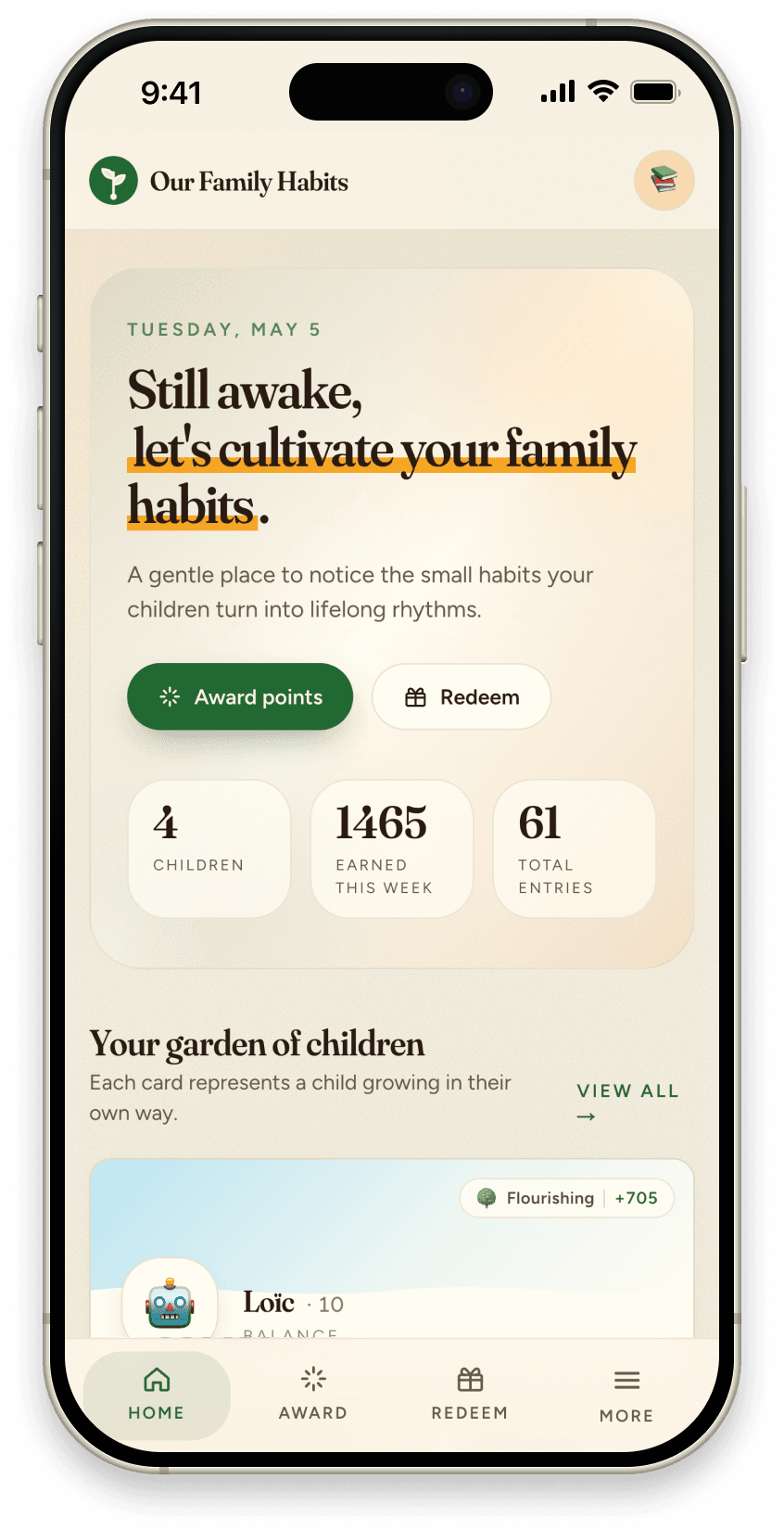
We built Our Family Habits with this view in mind. Actions are habits worth tracking — not just chores, but the smaller things Mason cared about: attention, neatness, kindness, truth-telling. The point isn't to gamify them. It's to make the slow work visible enough that you keep doing it.
The growth stages — Seedling, Sprout, Bloom, Harvest, Garden — are deliberately patient. Nobody jumps stages in a week. The shape of the chart matches the shape of habit-training: slow, then steady.
If you're already running a Mason-shaped home, the app shouldn't disrupt anything. It should just give you a quiet ledger for work you were doing anyway.
A starting point
If you're new to Mason and want to try this in your home, pick one habit. Just one. Choose something small enough to be daily — put your shoes by the door when you come in. Practice it for two weeks. When it's automatic, add the next.
You'll feel the urge to skip ahead. Resist it. The whole approach rests on letting each habit settle before adding the next.
That's the work, in three sentences: pick small, repeat patiently, add slowly. The rest is showing up every day until showing up is what your family does.
For the bigger picture of how these patient, one-at-a-time habits add up over the years, see how a family habit tracker builds strong families and lasting rhythms.