From chore wars to teamwork: how shared visibility changes a family
When everyone in the house can see the same picture, the conversations change. Here's the small shift that makes a big difference.
By Jon Horton ·
In the homes I’ve watched closely — including my own — chore arguments tend to come from the same place: kids genuinely don’t know what their siblings have done. Each child knows their own work in vivid detail, and each child has a vague sense that the others have done less. Both feelings are usually right and wrong at the same time.
Then a parent walks in. They have to mediate. They didn’t see most of what happened. They make a judgment call, somebody feels treated unfairly, the friction continues into the next day.
The shift that helps isn’t about chores. It’s about visibility.
Why parents become referees
Most family systems put the parent in the position of arbitrator-in-chief. If a child wants credit for something, they have to advocate to the parent. If they feel a sibling is slacking, they have to report it. The information flows through one bottleneck — you — and your judgment is the final word.
This is exhausting for parents and disempowering for kids. It teaches them that fairness is a thing they get from authority, not a thing they can see for themselves.
Shared visibility changes the question
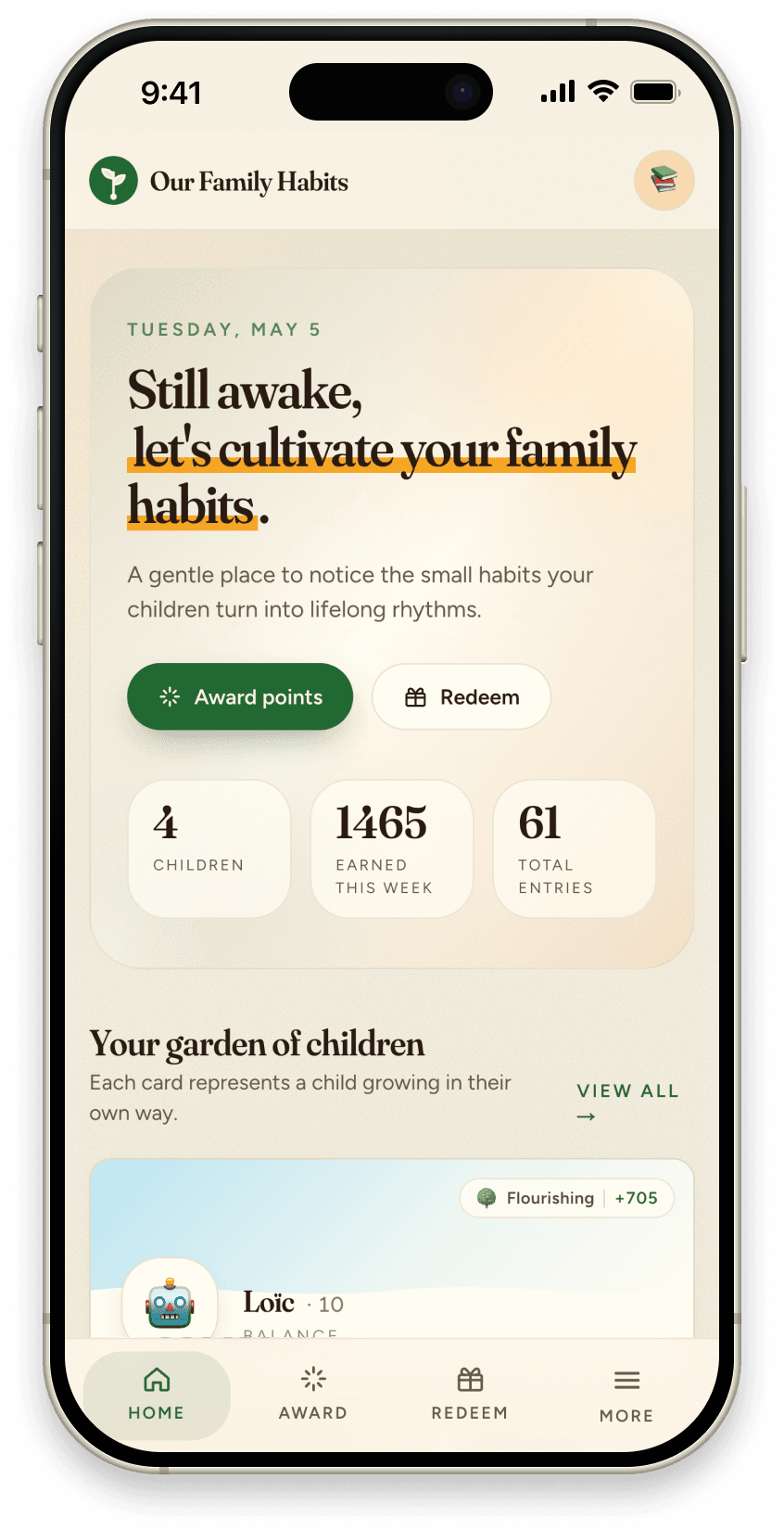
When the family kiosk shows what everyone earned today, the question stops being who did more? and becomes what did each of us actually do? It’s a different conversation. It’s also a much shorter one, because the answer is right there.
In our house, the moment we put the kiosk where everyone walks past it, three things changed:
-
The arguments dropped. Not all of them — kids will be kids — but the “I did more than her!” ones nearly stopped. The numbers are right there.
-
The older one started helping the younger one. Once you can see that helping a sibling is its own action with its own points, the helper stops feeling like a sucker. They get credit. The younger sibling doesn’t get punished for needing help.
-
The parents stopped being the mediators. I can’t overstate how much energy this gave back. We weren’t arbitrating fairness anymore. The system was.
The kiosk as a small institution
What I didn’t expect was that the kiosk would start to feel like a third party in the house — not a screen, but a kind of institution. The kids will look at it before asking us. They’ll point to it when they make a case. They’ll high-five each other when someone hits a growth stage.
That sense of the system is the system, and we all see the same thing turns out to be the foundation of teamwork. It’s hard to be a team when half the team only knows their own work. It’s easier when everyone’s reading from the same page.
What to do this week
If you have multiple kids and the chore wars feel relentless, try the following:
- Pick three or four daily actions everyone in the house contributes to (cleaning up after dinner, helping a sibling, music practice, etc.).
- Set them up with a points value that feels honest about effort.
- Put the kiosk somewhere everyone walks past.
Then sit back and listen. The arguments will move from who did what to what should we do next. That’s the goal — not silence, but better questions.
Shared visibility is one piece of a larger pattern. For how it fits the whole, read how a family habit tracker builds strong families and lasting rhythms.