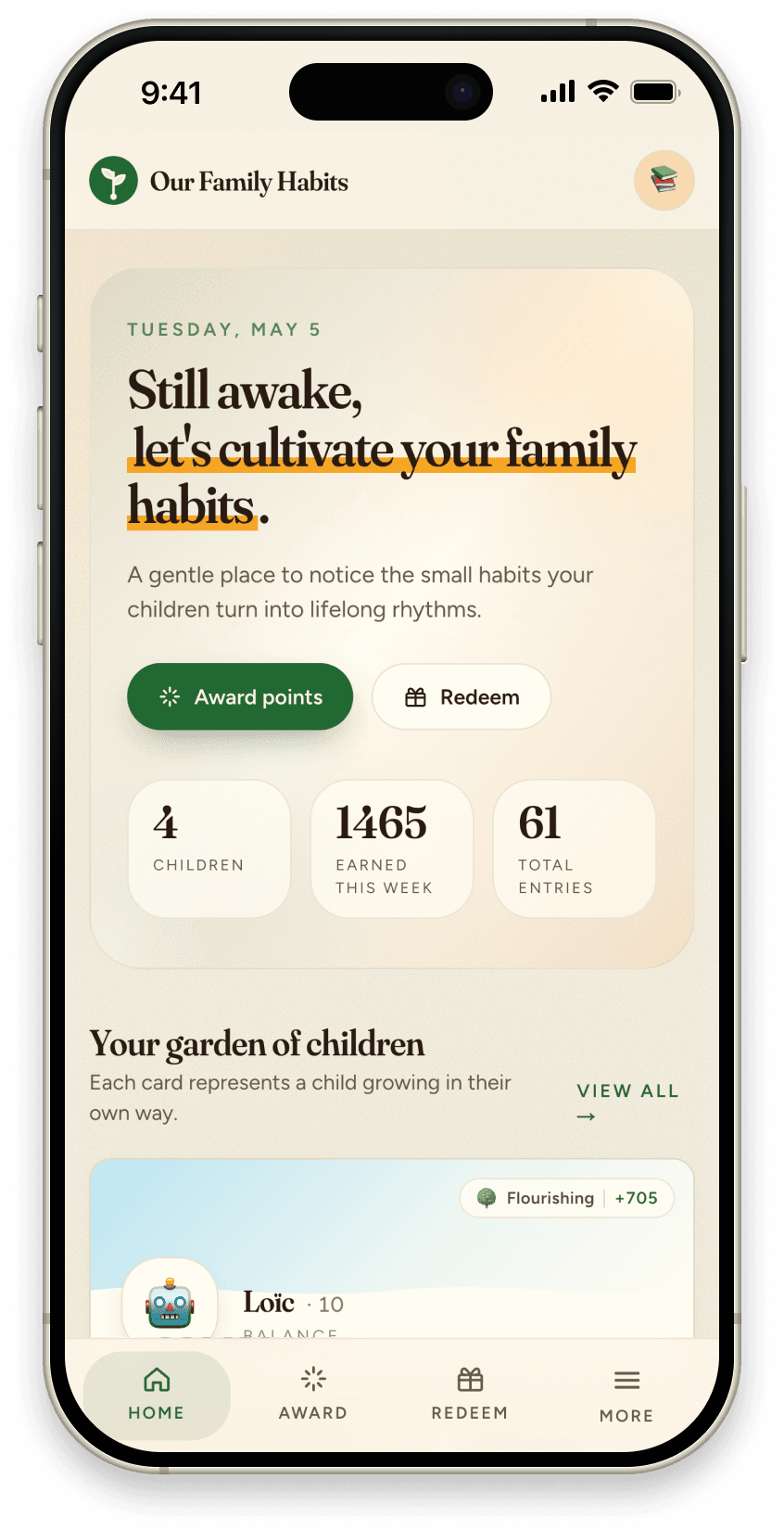
How to introduce a habit chart your kids actually engage with
Most habit charts fail in the first two weeks. Here's the gentle way to start so your family stays with it past the novelty.
By Jon Horton ·

The first habit chart I ever made for our kids lasted nine days. I drew it on a whiteboard, color-coded by child, and put it in the kitchen with the kind of energy that turned out to be the problem.
The thing kids smell faster than anything is parental performance. A new system you've decided about feels like a test they didn't sign up for. By day ten the chart was a guilty thing on the wall, and we quietly took it down.
What works instead is much smaller.
Start with one habit, not seven
The temptation is to capture everything that's been bothering you all week — practice, reading, manners at the table, room cleanup, screen limits. Don't. Pick the single habit that you both already mostly agree matters, and start there.
For one of our kids it was practicing piano. For another, it was making the bed before breakfast. The wrong habit to choose is the one you've been nagging about for a month — that's a battlefield, not a starting line.
Let them help name it
A habit called "Morning Reset" lands differently than "make your bed and put your pajamas away." You'll probably end up with the same five steps, but the kid who named it owns it.
Inside Our Family Habits this is just an action with whatever wording you settle on. The point isn't your description; it's theirs.
Award generously, especially in week one
The math you set up matters less than the rhythm of being noticed. If a 6-year-old earns 5 points for the new habit and you award it daily, by Friday they have 25 points and a sense that this thing produces something. That's the loop you're building — not the precise economy.
Once the loop is alive, you can adjust point values, add new actions, raise the cost of rewards. Don't try to design the perfect system before there's any motion.
Add the second habit only after the first is automatic
Two weeks is a reasonable rule of thumb. If the morning bed-making is mostly happening without prompting, you have headroom for the next thing. If it's still a fight, the system isn't ready for more. Adding a second habit too early is the most common reason these things collapse.
What to do when motivation dips
It will dip. Around week three, the novelty fades and you'll see attention drift. Three things help:
- Don't punish a slow week. The chart is for your child, not against them. Say nothing, keep awarding what they do, let the system carry itself.
- Add a small new reward. Not a bigger one — a smaller one priced low enough that they can earn it in a few days. A near-term win re-engages the loop.
- Talk about what's working. "I noticed you've been getting yourself ready in the morning without me asking. That's a big deal." Words do most of the work; the chart just makes the words available.
The long view
A year in, you stop watching the chart. The habits have become invisible — what Charlotte Mason called the easy track of well-worn associations. The chart will still be there, quietly counting, but you'll find your family barely needs to look. That's the goal.
Habit-forming is the slow work of letting a few small things repeat themselves until the kid no longer has to decide each morning. The chart is the scaffolding, not the building.