Free Chore Apps for Families: What 'Free' Actually Gets You
Searching for free chore apps for families turns up a lot of options and not much honesty about what's actually free. Here's the real taxonomy—truly free, freemium, and trial-with-a-clock—and what to check before you set your whole family up in one.
By Jon Horton ·

I searched "free chore app" at 9pm once, same as you're probably doing now. Five kids, a fridge chart that stopped working around year two, and a phone in my hand at the exact hour parents make decisions they later regret. I found six apps that called themselves free. By the time I'd set one up, added five kids, and hit a wall that said upgrade to add more than two children, it wasn't 9pm anymore.
That's the honest starting point for anyone looking at free chore apps for families: "free" on the app store listing and "free" once your actual household is inside it are two different words wearing the same four letters.
Is there a truly free chore app for families?
Yes, a few—but "truly free" and "free with a catch" get sorted into the same search results, and the label doesn't tell you which one you're looking at. In practice, what calls itself free splits into three categories:
Truly free. No paywall, no card, everything works. The tradeoff is usually somewhere else—ads, a design that hasn't been touched in years, or a company that's clearly not investing in the product anymore. Free because the business model is elsewhere, or because there isn't one.
Freemium. Free to download, free to use—until you hit the feature your family actually needs. A second parent account. A third kid. Approval workflows. A reward store instead of a bare checklist. The free tier is a demo shaped like a product, and the wall shows up exactly when you've invested enough setup time that leaving feels expensive.
Free trial with a clock. Full-featured, genuinely good, fourteen or thirty days, then a subscription. Nothing dishonest about this one—it's labeled a trial—but it gets typed into "best free chore app" searches anyway, and families set up their whole system on day one without registering that day fifteen is coming.
None of these is automatically the wrong choice. What's wrong is not knowing which one you're in before you've built your kid's routine on top of it.
What do the well-known free chore apps actually give you free?
Worth being specific, because vague answers are how people get burned. We compared the field in more depth in the best chore apps for families—here's the free-tier slice of it.
OurHome is the closest thing to truly free chore-and-allowance tracking on the market—multi-kid, parent approval, point values, no card required. The gap is kiosk mode: there's no shared-device setup, so younger kids who can't type a login can't log themselves in.
Cozi has a free tier and a to-do list that looks like a chore chart at a glance. It isn't one—no parent approval, no rewards, no shared-device mode. It was built to stop double-booked Saturdays, and the chore feature is a bolt-on that shows its seams fast.
Habitica is free and stays free, RPG mechanics and all—but it's built for one user managing their own habits, not a family. No parent approval, no multi-kid framing.
RoosterMoney offers a limited free tier before nudging toward its paid plan.
BusyKid, Greenlight, and FamZoo are honest about being trial-only—real banking rails, real money, and a subscription is how that business works. Worth it if a debit card and real allowance is actually your goal. Not a "free chore app" search in good faith if it is.
Joon runs a trial with no meaningful free tier past it. Goally isn't really an app-free-tier question at all—it's a piece of hardware.
What's the real cost of a "free" chore app?
Not the subscription. The subscription is the visible cost, and it's the one every comparison article focuses on because it's the easiest number to put in a table. The real cost is three steps earlier:
You set up every kid's name, age, and chore list. You explain the system at dinner. You get buy-in—genuine buy-in, the kind where your seven-year-old is actually excited to tap a checkbox. That's the expensive part, and it's expensive whether the app is free or not, because it's your time and your kid's trust, not money.
Then, week three, you hit the wall. Maybe it's a paywall. Maybe it's just that the free version was never going to hold five kids and a reward system, and you knew that on some level when you signed up but hoped it wouldn't matter. Either way, you're not just choosing a new app—you're re-selling the whole idea to kids who already bought in once and watched it fizzle. That's a harder sale the second time, and we've written about why the fizzle itself happens even with the right app—see why sticker charts stop working for the underlying pattern.
What should you check before you set one up?
Run the week-three test before you type in a single kid's name, not after:
- Does the free tier hold your actual number of kids? Not "up to two" if you have three. Check the limit, not the marketing page.
- Is parent approval free, or a paid feature? A chore system without approval is an honor system, and the honor system is usually what broke your last one.
- Is there a shared-device or kiosk mode, or does every kid need their own login? If your youngest can't type a password, this isn't a small detail.
- What happens to the reward system specifically? A points-and-privileges store—not just cash—is often the first thing locked behind a paywall, because it's the feature that makes an app worth paying for.
- If it's a trial, is the date written down somewhere other than the app itself? Put it on the calendar. The app will not remind you helpfully.
How do the main options compare?
| App | Free tier | Multi-kid on free | Parent approval on free | Kiosk / shared device | Reward store beyond cash |
|---|---|---|---|---|---|
| Our Family Habits | Yes, no card | Yes | Yes | Yes | Yes |
| OurHome | Yes | Yes | Yes | No | Points, no store |
| Cozi | Yes | Yes | No | No | No |
| Habitica | Yes | Not family-built | No | No | No |
| RoosterMoney | Limited | Limited | Yes | No | Savings goals |
| BusyKid / Greenlight / FamZoo | Trial only | — | — | No | Cash only |
| Joon | Trial only | — | Yes | No | Game-based |
| Goally | Hardware | Hardware | Yes | Tablet (hardware) | — |
Most of the field asks you to pick between "free" and "actually built for more than one kid." That's the gap worth naming before you commit a week of setup to any of them.
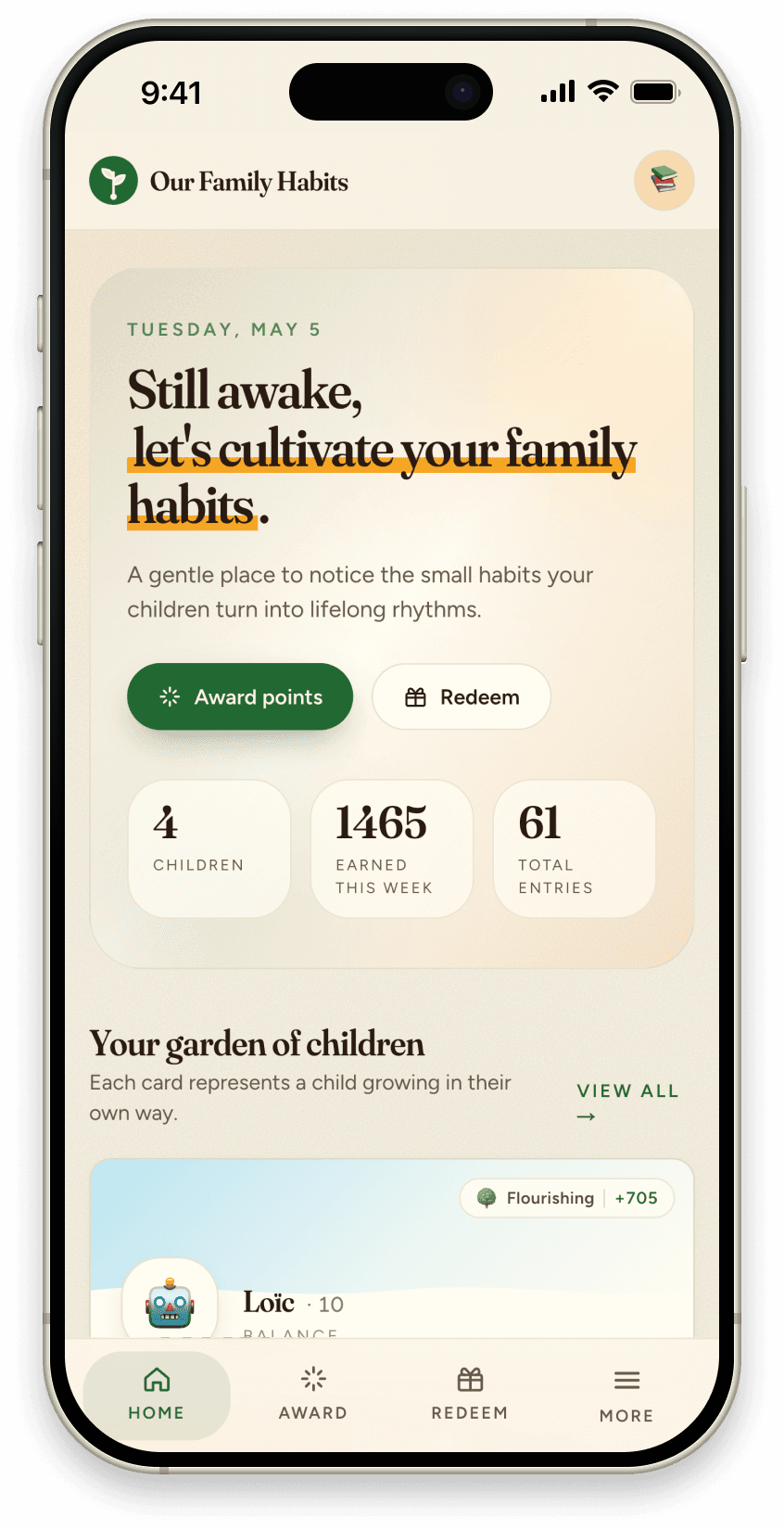
If you'd rather not run that test five times before dinner, Our Family Habits is free to start, no card required, and the core loop—chores, approval, a shared tablet, a reward store that isn't just cash—works on the free tier. Not because the exit is blocked. Because the bet is you'll stay for what it does.
Is Our Family Habits actually free, or is this the same trick?
Fair question, given everything above. The honest version: free to start, no card on file, and the features that make the other freemium apps worth paying for—multiple kids, parent approval, a shared kiosk, a real reward store—aren't the wall. Pricing exists for families who outgrow the free tier on scale, not for families who hit a wall on week three because the basic loop was never really free. Read the details there rather than take our word for the specifics—we'd rather you check than trust a claim in an article we wrote about ourselves.
One step
Don't audit six apps tonight. Pick the one question from the list above that actually matters for your house—probably "does the free tier hold all my kids"—and check it before you set anything up. If you want to skip the check entirely, start with Our Family Habits free. No card, no trial clock, just your family's actual chore list on a shared tablet by dinner.