Chore apps for couples and adults: the fight was never about the dishes
Chore apps for couples and adults promise a fairer split. Most just automate who assigns what. Here's why the real fix is making the household's knowledge visible—not handing out tasks—and what to do about it whether it's two adults, roommates, or a full house.
By Jon Horton ·

Two days in, the mug was still in the sink.
Neither of you had said anything about it. That's not because neither of you cared—it's because you were both testing the same question without saying it out loud: whose job is it to notice this?
If you've searched for a chore app for adults, you already know that fight. It rarely starts with the dishes. It starts with one person doing the noticing—every day, for everything—while the other person does the doing, and only when asked. One of you is running a small operations department in your head: what's dirty, what's due, what your partner forgot, what you'll have to remind them of tomorrow. The other person genuinely doesn't see the list, because they've never had to hold it.
That's the mental load, and it's got nothing to do with effort. Plenty of the partners on the "doing" side work just as hard, just as long. What they don't do is carry the knowing—the constant background awareness of what needs to happen and when. A chore app that just assigns tasks doesn't touch that problem. It hands out jobs to the same person who was already the only one paying attention, just with a nicer interface.
What problem is a chore app for couples actually supposed to solve?
Not "who does more." That's a scorekeeping question, and scorekeeping is a symptom, not the disease—two people counting because neither trusts the count to be visible without them doing it personally.
The actual problem is that the household's operating knowledge lives in one person's head. Trash night, the vet appointment, whose turn on dinner, the towels that need washing before Thursday—if all of that only exists as a mental list one adult carries, then noticing is that person's permanent, unpaid job, no matter how the physical chores get split.
The fix isn't a fairer split of tasks. It's moving the knowing somewhere both of you can see it—so noticing stops being a personality trait and starts being something the system does. We wrote about this exact shift from a parent's-eye view in how to be consistent with chores when it all depends on you—same architecture problem, whether it's one parent running seven kids or two adults running a two-person household.
Do chore apps for adults actually work?
Some, for a while. Most fail the same way sticker charts fail with kids: they work for the two weeks someone's enthusiastic about setting them up, then die because the app requires exactly the thing you were trying to get away from—one person remembering to assign, chase, and check.
A chore tracker app for adults—or a chore chart app for adults, whatever you call it—works when it does three things a mental list can't:
- Makes tasks visible without a conversation. Neither partner has to ask "did you do X" or announce "I'm doing X"—it's just there, readable, done or not done.
- Removes the assigning. If one adult is still deciding what the other does today, you haven't fixed the mental load—you've automated the manager side of a manager/employee dynamic. The healthier version is a shared list both adults can add to and pull from, not one person's dispatch board.
- Doesn't require daily maintenance to stay honest. If keeping the app accurate becomes its own chore, it becomes one more thing for the same person to carry.
Points and rewards, which do a lot of work for kids, are optional for adults. You're not motivating a nine-year-old with screen time—you're both grown-ups who already know the trash needs to go out. What you need isn't a bribe. It's visibility. A running tally that shows what got done this week, without either of you keeping it in your head, does more for a marriage than a points economy ever will.
What about chore apps for roommates?
Same shape, lower stakes. A chore app for roommates that divides bills and chores by turn exists for a reason—shared space needs shared visibility even when nobody's emotionally invested in whether the counter gets wiped. If that's your situation, a straightforward rotating task list solves most of it, because roommates usually don't have the deeper layer couples do: nobody's managing anybody, and nobody's expected to just know what the other person needs. Worth naming, then moving on—the harder version of this problem, the one worth actually solving well, is the couple's version.
What if you also have kids?
Here's the turn that changes the whole calculation.
If you're searching for a chore app for couples because you've got kids in the house, an adults-only split only solves half the problem. You'll have fixed the fight between the two of you and left the exact same mental-load pattern running for the kids—one parent still the only one who knows whose turn it is to set the table, still the only one tracking who did their reading, still doing the noticing for four or six people instead of one partner.
The better move is running the whole household on one visible system—not a separate app for the adults' split and a separate chore chart for the kids. The same shared picture that shows your partner the trash needs to go out can show your ten-year-old it's her turn to feed the dog, without you standing in the kitchen assigning either one. That's the actual promise of a household chore app done right: it's not built for kids with adults bolted on, or for adults with kids as an afterthought. It's one system the whole family reads.
How do you set up a chore app so it actually sticks?
The setup matters more than the app. A few things we've seen actually hold:
- Put it somewhere physical, not just on two phones. A shared list buried in an app neither of you opens unprompted is just a digital version of the same mental list. A kiosk on the kitchen counter—an old tablet, always on, always visible—means the day is readable by whoever walks past, not just whoever remembers to check their phone. We cover the setup in turning a spare tablet into a family command center.
- Build it together, once, calmly. Not mid-argument about the sink. Sit down when you're not annoyed and write down what actually needs to happen in a normal week—recurring and one-off both.
- Let both of you add to it. The list isn't one person's to maintain. If only one adult ever adds tasks, you've rebuilt the manager dynamic with better software.
- Check it instead of asking. The whole point is that "did you do the thing" stops being a sentence either of you has to say out loud.
One step
Don't redesign your whole household this week. Pick one thing—one recurring task that's currently living only in someone's head—and put it somewhere you can both see it. Notice how much quieter that one thing gets.
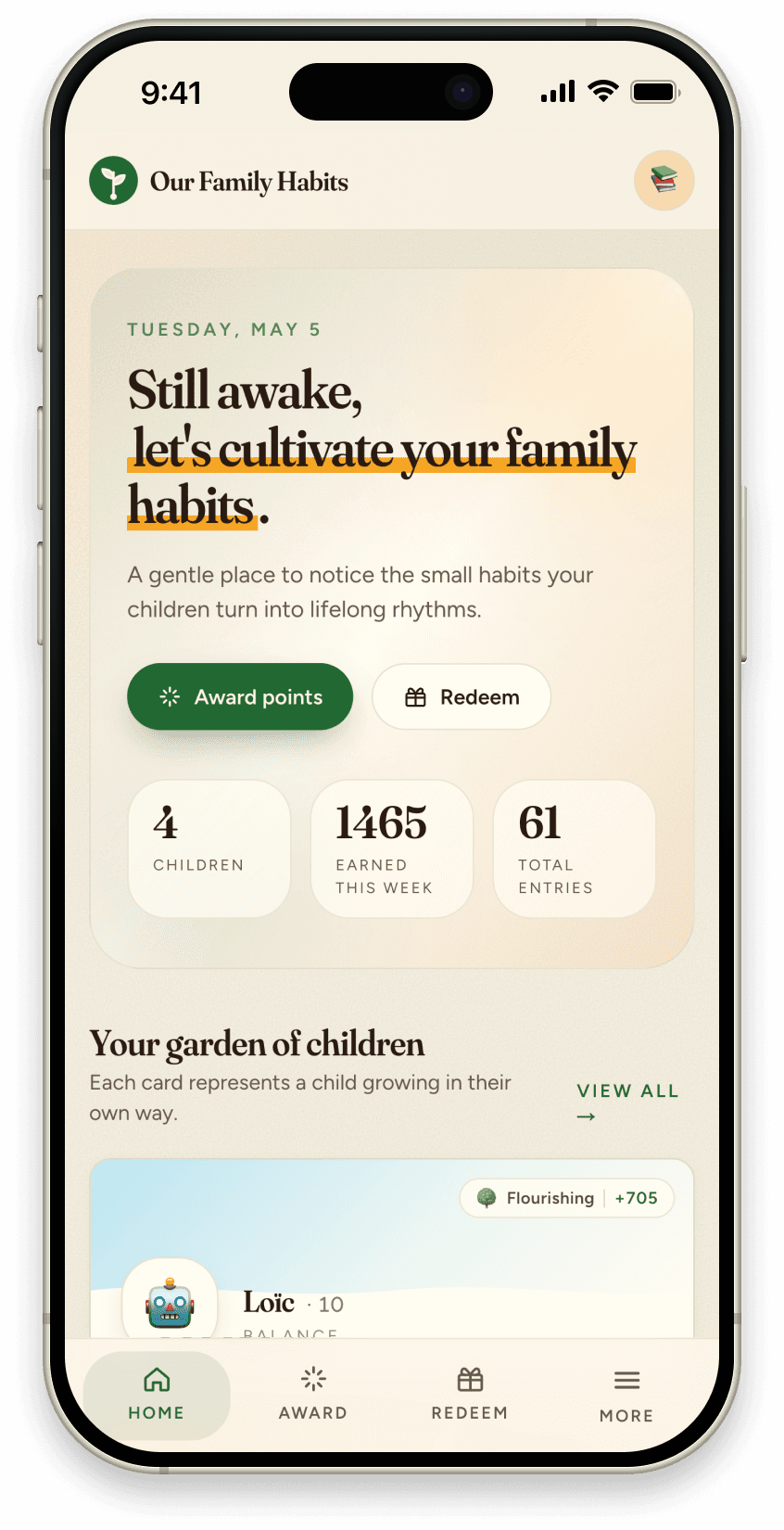
Our Family Habits runs that for the whole house—couples, kids, the works—one visible system instead of one tired person's memory. Start free, no card needed.