Weekly Chore Schedule for Kids: Build a Rhythm, Not a Plan
Most weekly chore schedules for kids are plans you rebuild every Sunday. The ones that last are rhythms: set once, repeated on the same days, until the doing becomes who your kids are. Here's how to build one for several kids with different days, and why the repetition is the point.
By Jon Horton ·

It's 7:40 on a Tuesday.
One kid is asking if it's her turn on the dishwasher. Another has his special class today, Tuesday, and he's already forgotten. The youngest wants to know if the litter box is hers today or if that was yesterday. Somebody has to get the trash out by noon. And I'm standing in the kitchen reading the week out loud from the only place it lives.
My head.
Here's what struck me, standing there. None of it was new. It was the same Tuesday as last Tuesday. Same dishwasher, same Tuesday class, same litter box. I wasn't reading out a plan. I was reading out a rhythm, every single morning, because it had never been written anywhere the kids could see it.
We have five kids. I've made plenty of weekly chore schedules. The ones that failed were plans. The ones that lasted were rhythms.
What's the difference between a weekly plan and a rhythm?
A plan is something you build for one week. A rhythm is something you set once and let repeat: these things happen every day, these on certain days, for these kids. You don't redo it on Sunday night. You change it when a season changes.
That difference matters more than any template.
A plan asks you to show up every week and rebuild the family's expectations from scratch. A rhythm asks you to decide once what your family does, and then get out of the way.
And a rhythm does something a plan can't. It repeats.
Why do rhythms build habits that last?
Because a habit is an action repeated in the same place until it stops needing a decision. Rhythms supply the repetition. The same thing, on the same days, at roughly the same time, week after week.
Charlotte Mason, who put habit at the center of how she taught children, borrowed a line for it: habit is ten natures. What a child does over and over becomes part of who they are. We wrote more about what she meant.
Think about what that means in practice.
A child who makes her bed every morning for a year isn't deciding to make her bed anymore. She just does. A child who does her own chores every Friday morning stops negotiating about them on Fridays. The rhythm made the decision a long time ago.
That's what we're really after with chores. Not a clean kitchen this week. Kids who grow into adults who take care of the things in front of them without being asked.
Plans can't do that, because a plan changes every week. You can't form a habit around something that keeps moving.
How do I make a weekly chore schedule for my kids?
Set the rhythm once: list what repeats, decide which days each thing happens and for which kids, then put today's list somewhere the kids can see it without asking you. After that, leave it alone.
Here's the order that works for us:
- List what you want to repeat. Not just chores. Reading, school, brushing teeth, the litter box. If you've said it out loud three times this week, it's a rhythm waiting to be written down.
- Give each one its rhythm. Every day. Certain days (special classes on Tuesday and Thursday, chores every Friday morning). Or a few times a week, any day.
- Decide who. Some rhythms are for the whole family ("make your bed"). Some belong to one child on their own days.
- Add a time only where it matters. "Trash out by noon" needs a time. "Scoop the litter box" probably doesn't. Too many times turns a rhythm into a cage.
- Put today where the kids can see it. A fridge chart, a whiteboard, a tablet on the counter. Somewhere a seven-year-old can answer "what's left?" by herself.
- Then don't touch it for a month. The repetition is the point. Resist the urge to tinker.
Start small. Five or six rhythms. Add one more only after the first ones hold.
How do I give different kids different chores on different days?
Give each child their own days for the jobs that rotate, and keep the shared rhythms on one line for everyone. Most families need both.
For rotating jobs, a fixed rotation keeps it fair without a negotiation every Sunday. Because it's a rhythm, each kid knows their days by heart within a few weeks:
| Kid A | Kid B | Kid C | |
|---|---|---|---|
| Mon / Thu | Dishwasher | Litter box | Sweep |
| Tue / Fri | Litter box | Sweep | Dishwasher |
| Wed / Sat | Sweep | Dishwasher | Litter box |
Then layer each child's own rhythm on top. In our house, every child has their own chores on Friday morning, and special school classes land on Tuesdays and Thursdays. None of that fits a chart where every kid gets the same row, and all of it repeats every week.
Printable chore chart or app: which works better for a weekly routine?
A printable works when your rhythm is simple and your kids are young. An app works better once different kids have different days, because it can turn the rhythm into today's list on its own, every day, without anyone reading a grid.
I'll grant the printable its due. It's cheap, it's visible, and for a four-year-old a laminated chart with pictures is hard to beat. Picture-based routine apps like Choiceworks are built for exactly that age.
But a printable has to be read correctly every morning. Someone has to find today's column, find their row, and remember that it's Thursday. That someone is usually you, which means the rhythm still runs through your voice.
Here's what to look for in an app if you want the rhythm to carry itself:
- Repeating by day, per child. Special classes on Tuesday and Thursday for the kids who take them, without putting them on everyone's list.
- Shared and personal rhythms together. One habit for the whole family, others for one child, in the same week.
- Set once, repeats forever. If you have to rebuild it weekly, it's a planner, not a rhythm.
- A today view the kids can read. Not a calendar. A short list of what's left.
- Streaks that respect the rhythm. A Tuesday and Thursday habit shouldn't "break" on Wednesday.
Plenty of apps cover part of this. Allowance apps like RoosterMoney and BusyKid let you pick the days a chore repeats, but the whole system leans on money. Cozi gives you shared lists the kids can check off. Visual schedule apps handle one child's routine well. What's harder to find is the whole family's rhythm in one place, with each kid's days and a today list everyone can see.
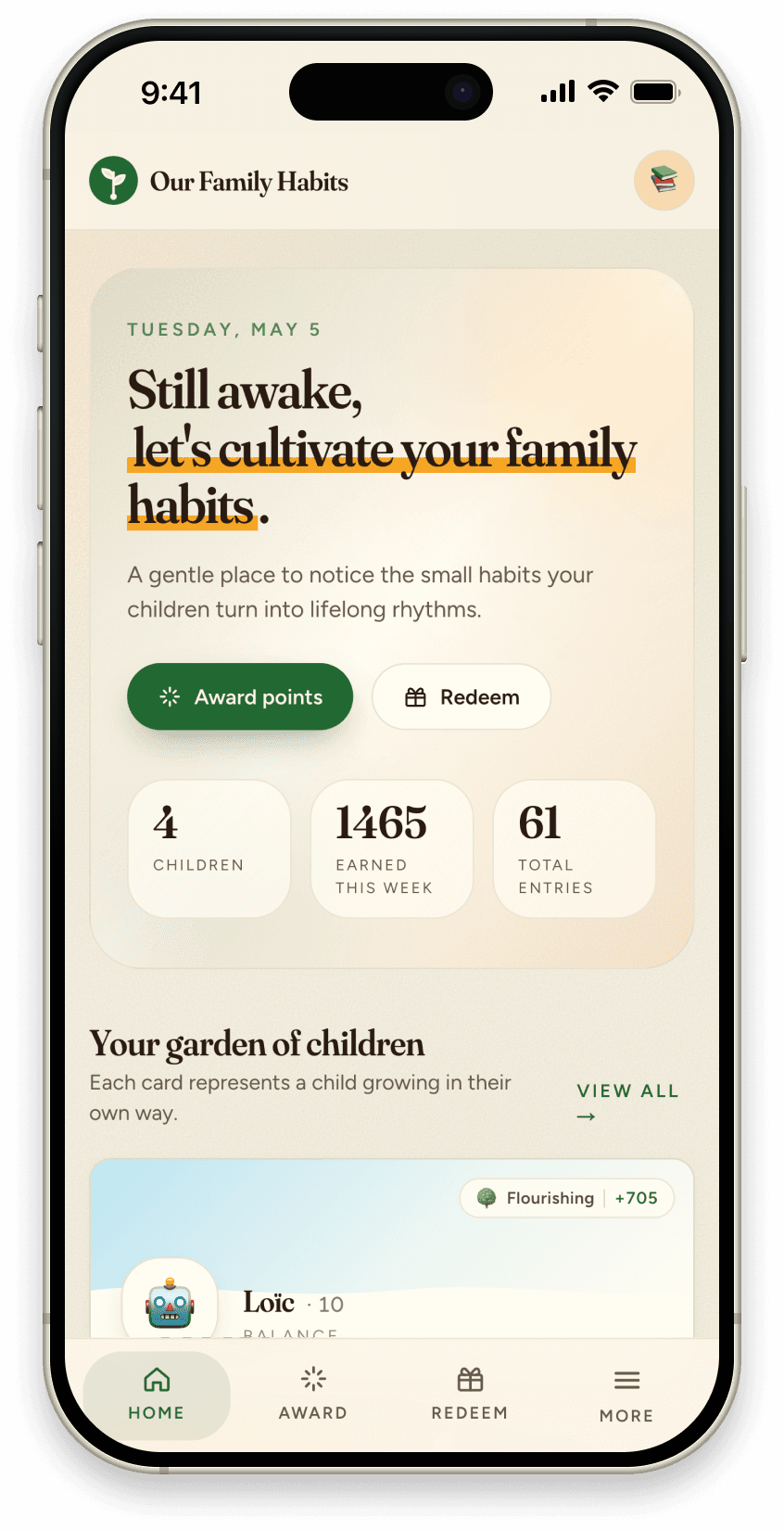
A disclosure: we built one. It's called Our Family Habits, and the next section is how it works. Judge it against the list above, not against my enthusiasm.
How we set our family's rhythm
We set it once, in the weekly rhythm planner. It shows Sunday to Saturday with an Everyone row and a row for each kid. Make your bed sits on Everyone, every day, and so does trash out by noon. Each kid's Friday chores sit on their own row, Friday morning. Special classes sit on Tuesday and Thursday for the kids who take them.
Then it repeats. Every week, without anyone rebuilding it.
Each morning, the Today tab turns that rhythm into today's list. It's on a parent's phone, and on a tablet on the kitchen counter. Each kid taps their name and sees what's left for them, today. When they finish something, they tap it, and it moves to done.
A small 🔥 shows up on a kid's face once a habit has a run going, and the run follows the rhythm, so off days don't count against them. That's the habit becoming visible.
We only open the planner again when a season changes: a new school year, a new class, a child old enough for a new job.
How do I keep a rhythm going when every week looks different?
Keep the rhythm and skip the exceptions. A dentist appointment or a field trip is a one-off; it doesn't change what your family does most weeks. Rebuilding everything around a strange week is how rhythms die by October.
A few things that help:
- Separate the rhythm from the calendar. The rhythm is what happens most weeks. The calendar is this week's appointment. Don't mix them.
- Skip a day instead of deleting the habit. A sick day is an exception, not a reason to start over.
- Change rhythms by season, not by week. New school year, new rhythm. Random Tuesday, same rhythm.
- Add one new habit at a time. Let it hold for a few weeks before adding the next.
How can kids see their own to-do list without asking me?
Put today's list on a screen they walk past, and make it theirs to check off. For most families that's a spare tablet on the kitchen counter.
We wrote about setting up a family kiosk if you want the details. The short version: when the rhythm is somewhere kids can read it without you, you stop being the reminder. A rhythm that depends on a parent's voice only works on the parent's good days, and it makes you the thing they push against.
Where to start this week
You don't need a perfect schedule. You need the rhythm out of your head and somewhere it can repeat.
What do you want your kids still doing at twenty-five? Making their bed? Practicing something hard? Taking care of what's theirs without being asked?
Pick three. Give each one its days and its kids. Put today where everyone can see it, and let it repeat.
If you want the rhythm planner and the Today tab carrying that for you, start a free 14-day trial of Our Family Habits. Every trial includes the planner, the Today tab, and kiosk mode, so you'll know within a few weeks whether the rhythm holds.