Why is everything a fight? How to end the daily power struggle over chores
When every chore turns into a negotiation, it isn't a willpower problem in your kid. It's that the rule lives in you — so you're the thing they push against. The fix is to move the expectation out of your hands and into a system the whole family can see.
By Jon Horton ·
The dishwasher had been sitting there, clean, since breakfast.
I asked my son to empty it. He said he would in a minute. The minute passed. I asked again, a little sharper. He told me it wasn't his turn — it was his sister's. His sister, from the other room, said it absolutely was not. Within ninety seconds a clean dishwasher had turned into a court case, and I was the judge, the prosecutor, and the guy who still had to make dinner.
That's the part nobody warns you about. It's rarely the chore that wears you down. It's that the chore is never just the chore. It's a negotiation, a fairness dispute, a test of whether you really mean it today. By the time it's done, you've spent more energy litigating the thing than the thing would ever have taken.
And you start to wonder what's wrong with your kids. Why is everything a fight?
It's not defiance. It's the design.
Here's what finally changed how I saw it.
The fight wasn't happening because my kids were uniquely stubborn, or because I'd failed to be firm enough. The fight was happening because I was the rule. The expectation didn't live anywhere except in my head and my voice. So every single time I asked for something, I wasn't pointing at a standard — I was the standard, in the room, available to argue with.
Think about what that means in practice. If the only place the rule exists is in a parent's mouth, then the rule is only as solid as that parent's tone in that moment. Kids are brilliant at reading that. They can hear the difference between a tired "please empty the dishwasher" and a one that means it. So they test — not because they're bad, but because the boundary is made of a person, and people can be worn down, distracted, out-waited, or out-argued.
A boundary made of a person is a boundary you can push against. And kids will push against it every time, because pushing sometimes works.
We wrote about a version of this in from chore wars to teamwork — the way a house can slide into parent-versus-kid combat without anyone choosing it. The power struggle isn't a character flaw in your family. It's the predictable result of a system where the only authority is a human one you can negotiate with.
What a kid is actually fighting
It helps to be honest about what's underneath the resistance.
A lot of the fight isn't really about wanting to get out of the work. It's about not knowing where the edges are. When the expectation shifts with your energy — strict on a good day, let-it-slide on a hard one — a kid can't tell what's actually required. So they probe. Every ask becomes a question: Is this real today? How real? What happens if I don't?
That probing looks like defiance. Mostly it's a kid trying to find a wall that doesn't move.
Children settle when the frame is steady. Predictability is one of the deepest inputs to a child's sense of security — when the same things matter every day and the same effort earns the same response, there's nothing left to test, so the testing quiets down. The fights don't stop because you finally won one. They stop because there's no longer a moving target to aim at.
Move the rule out of your hands
So the goal stopped being win the argument. The goal became remove the argument.
The way you do that is to take the expectation out of your head and your voice, and put it somewhere outside of you — somewhere the whole family can see, that says the same thing whether you're rested or running on four hours of sleep. When the rule lives in a shared system instead of in you, the thing your kid is pushing against changes. They're not pushing against Mom's mood anymore. They're looking at what's true.
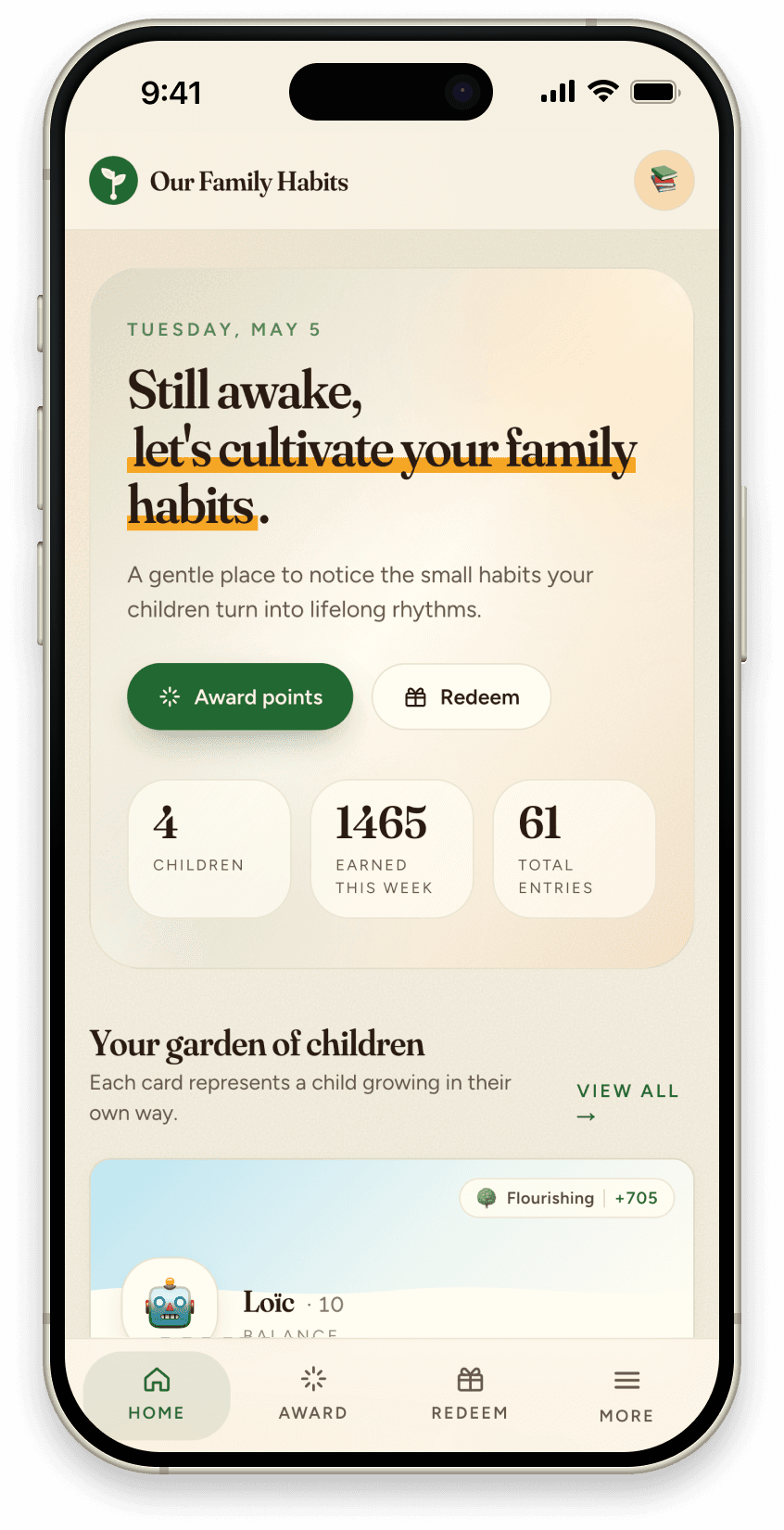
That's what we built Our Family Habits to be: not a chore app so much as a family operating system. The expectations live in the system, visible to everyone, so the parent stops being the rule and starts being the person who backs the rule.
In our house of seven, that looks like:
- The day's jobs are already set, on the kiosk everyone walks past. When my son asks whose turn it is, I don't adjudicate — we look. It's right there. The daily actions don't have a mood, and you can't out-argue a screen that just shows you the truth.
- Effort lands somewhere a kid can watch. Finishing a job earns points; points buy rewards they actually chose. The "why should I" question mostly answers itself, because the kid can see what the work is building toward. The motivation moved off of me convincing them.
- Fairness has a record now, not a referee. "It's not my turn" used to be my problem to settle from memory. Now there's a running tally the kids can check themselves. The argument has nowhere to go, because the answer isn't my word against theirs — it's just there.
None of that requires me to be more firm, more consistent, or more anything. It requires the rule to live outside of me.
The cycle that reinforces itself
Here's the part I didn't expect.
Once the expectation lives in the system, something starts to compound. The kids know what to expect, so they stop testing whether today is different. Because they stop testing, the days get smoother. Because the days get smoother, the habits actually take — and a habit that's taken doesn't need a fight to start it. The kid empties the dishwasher because that's what happens after breakfast, not because someone with enough authority finally made them.
That's the self-reinforcing loop. Predictability builds habit; habit deepens predictability. The structure does the heavy lifting that used to come out of your nervous system at six o'clock. And the kids aren't just complying — they're learning to work inside a frame, which is a skill they carry long after they've left your kitchen.
The fights didn't end because I got better at fighting. They ended because there was less and less to fight about.
Stop being the thing they argue with
You don't need our exact setup, and you don't need seven kids. The move is the same at any size: stop being the rule, and build one your family can see without you.
- Pick three or four daily actions that genuinely matter in your house, and start small — one habit, awarded generously, then tune from there.
- Put it somewhere everyone passes, so the expectation is visible instead of living in your voice. Our 10-minute kiosk guide covers turning a spare tablet into that hub.
- Let effort land somewhere a kid can watch climb, so the system is what motivates and settles disputes — not you, again, at the end of a long day.
Then ask for the dishwasher to be emptied. And notice that you're pointing at something, instead of being the thing your kid pushes against.
You can start with Our Family Habits free and build that frame once — so the next time something needs doing, it isn't a fight. It's just what comes next.