Charlotte Mason habit training and apps: does software betray the method?
Most habit-training apps outsource motivation to dopamine—the opposite of what Mason asked for. Here's the honest test for whether a tool can serve Charlotte Mason habits instead of undermining them.
By Jon Horton ·
A friend in our co-op put it to me straight: "I love the idea of a habit chart on the fridge. I do not love the idea of my six-year-old earning confetti and coins for putting his shoes away."
She'd tried one of the gamified chore apps. Her son loved it for eleven days. Then he wanted to know why the app wasn't giving him more coins for less work, and the whole thing collapsed into a negotiation about points instead of a habit about shoes. She uninstalled it and went back to a paper chart on the fridge, which is honest work but doesn't scale past a toddler or two.
If you're running a Charlotte Mason home, you already know why that app failed before I finish the sentence. Mason spent a great deal of ink on habit-training, and none of it was about coins.
So the real question isn't "is there an app for Charlotte Mason habits." It's whether any app can serve the method at all, or whether the two are simply incompatible.
Can an app really do Charlotte Mason habit training?
Mostly, no. Not the apps built for the mass market of chore-tracking, anyway. Those are built on a completely different theory of motivation than Mason held, and they work exactly as designed—which is the problem.
But narrow the question and the answer changes. Can a piece of software support the mechanics Mason actually asked for—one habit at a time, steady watchfulness, never letting an exception pass? Yes, if it's built for that job specifically rather than for the dopamine loop most habit apps chase. We wrote about the philosophy itself in Charlotte Mason on habit formation; this piece is the practical sequel—what it looks like to actually run her method day to day, with a tool that helps instead of hollowing it out.
What most habit-training apps get wrong
Open any of the popular kids' chore apps and you'll find the same design: a cartoon mascot, a coin animation, a streak counter that flashes when it's about to break, badges for effort thresholds. It's built by people who studied gamification, not child formation, and it works the way slot machines work—unpredictable small rewards that keep a kid checking back.
Mason's whole argument was the opposite of this. She wanted the habit itself to become the reward—an action so grooved into daily life it no longer needs an external push. "Second nature," in her phrase. A habit that only runs because a coin animation fires is not second nature. It's a habit rented from the app, and the moment the app stops paying, the habit stops running. That's not a hypothetical—it's exactly what happened to my friend's son on day twelve.
The deeper issue is that gamified apps outsource the very thing Mason placed in the parent's hands: the child's own effort of will. A kid earning confetti isn't exercising will. He's responding to a stimulus, same as a kid earning a sticker or a dollar. Useful for a season, maybe. Not what Mason meant by habit-training.
What Mason actually asked of the parent
Reread her on habit and a pattern emerges that has nothing to do with rewards. Three things, repeated across her writing:
One habit at a time. Mason was firm that a parent who tries to fix six habits simultaneously fixes none of them. Pick one. Work it until it's automatic. Then—and only then—add the next.
Watchfulness that never lapses. This is the part modern parents underrate. Mason's method depends on the parent catching every instance, not most of them. Let one exception slide—the untidy room excused because you're tired, the interrupted sibling excused because it's late—and the habit takes longer to set, sometimes measurably longer. Consistency isn't a nice-to-have in her framework; it's the mechanism.
Never let the exception pass. Same idea from the other direction. A habit under formation is fragile. It doesn't need harshness, but it does need the adult to notice, every time, and gently hold the line.
Read that list again and you'll notice something: it's exhausting to run entirely inside one parent's memory. Watchfulness that never lapses, held by a single tired adult across five kids and a full day, is a lot to ask. Mason wrote for mothers with fewer distractions competing for their attention than we have now. The method hasn't changed. The conditions for running it by memory alone have gotten harder.
So where does an app actually help?
This is the honest opening, and it's narrower than most software marketing wants to admit: a tool can't do the watchfulness for you, and it shouldn't try to replace your attention with its own. What it can do is make the watchfulness shared—move it out of one parent's head and into something the whole family can see.
That's the design principle behind Our Family Habits. Not gamifying Mason's method—tending it. A quiet checkmark when a habit is practiced. A visible rhythm on the kitchen kiosk so everyone, including you at the end of a long day, can see at a glance whether the one habit you're building actually happened today. No coin animation. No mascot. If you choose to attach a reward at all, it's optional and pointed at the real world—points toward a nature-study outing on Saturday, not a screen full of confetti.
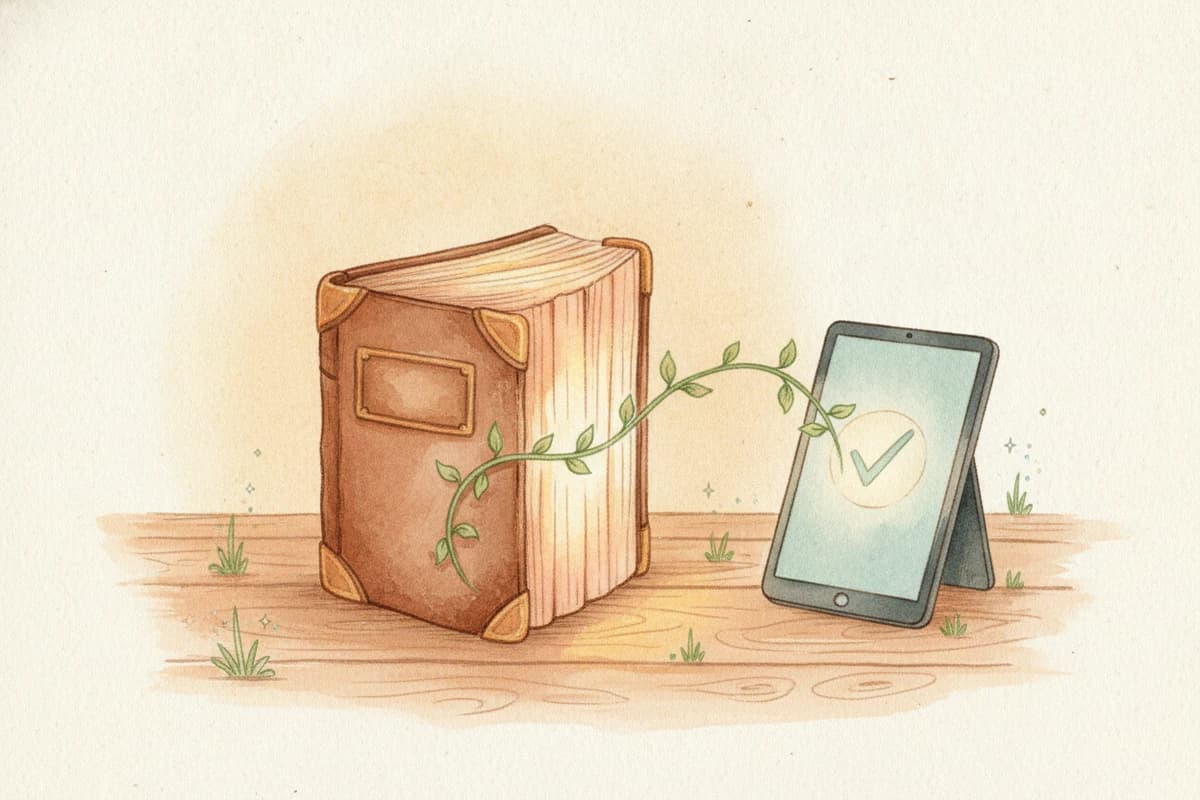
The shift is subtle but it's the whole thing: the watchfulness doesn't disappear into an app that runs the habit for the child. It moves from your moment-by-moment vigilance into a shared family picture everyone can check. You're not handing the formation over to software. You're getting backup for the one part of Mason's method that was never sustainable solo.
How do you run one-habit-at-a-time formation in the app?
Mason's sequence translates directly. Here's the practical version:
- Pick the one habit. Not a list. One. What is a family habit walks through choosing something small enough to be daily and specific enough to notice—"shoes by the door," not "be tidier."
- Set it up as a single visible action, not a chore with a price tag. This isn't a paid task; it's a habit under formation. Introducing a habit chart covers how to frame it so a kid understands the difference.
- Check it daily, together, at the kiosk. The point isn't the tap—it's the two seconds of shared attention that happen around it. That's your watchfulness, made visible instead of invisible.
- Let a slipped day show up as a slipped day. Don't hide it, don't punish it hard—just notice it, the way Mason asked, and pick the habit back up tomorrow. The system holds the history so you're not relying on memory to know it happened.
- Don't add a second habit until the first stops needing your attention. This is the step families skip and the one Mason was most insistent on. Resist it.
That's it. No leaderboard, no streak-break panic, no coins. Just a habit, watched consistently, until it's second nature.
One step
Pick the single habit you'd start with this week—just one. Set it up as a shared, visible action rather than a task on a list, and check it together at the same time each day for two weeks before you touch anything else. If you want a place to hold that habit without carrying the watchfulness alone, Our Family Habits is free to start, no card needed. You choose the habit. The system just helps you both remember to look.