What is a family habit? (It's not a chore list)
Search 'family habits' and you'll get lists: eat dinner together, go for walks, drink more water. Fine lists. But a family habit isn't an item on a list—it's a behavior your family runs on autopilot, together, without one parent carrying it. Here's the real definition, and how to build one.
By Jon Horton ·
Ask a search engine "what is a family habit" and you'll get the same answer twelve ways: a list. Eat dinner together. Take evening walks. Drink more water. Limit screens.
Good things, all of them. And almost none of them will survive September.
Here's why. Those lists define a family habit as a healthy thing families do. But that's a description of the outcome, not the thing itself. After seven kids and more abandoned charts than I can count, here's the definition I actually work from:
A family habit is a behavior your family performs on autopilot—predictably, together, without one person having to remember it, announce it, and enforce it every single time.
The last clause is the whole game.
What makes a habit a family habit?
A personal habit lives in one head. You brush your teeth without deciding to; nobody has to remind you. The habit runs itself.
Now look at most "family habits." Dinner together happens because mom cooked and called everyone. The evening walk happens because dad rounded everyone up. Chores happen because somebody asked, then asked again, then stood in the doorway. Strip away the parent driving it, and the behavior stops.
That's not a family habit. That's a parent habit with an audience.
A true family habit has three marks:
- Everyone knows what's expected—without being told. The eight-year-old knows the dishwasher gets emptied after breakfast the same way she knows shoes come off at the door.
- It runs on a trigger, not a reminder. After dinner → clear the table. Saturday morning → rooms get reset. The cue lives in the day itself, not in a parent's voice.
- It survives an off day. If the parent who usually drives it is sick, traveling, or just done, the habit still mostly happens. That's the test.
If a behavior fails that third test, it isn't a habit yet. It's a routine being manually propped up—and the prop is you.
Why "just be consistent" doesn't get you there
The standard advice is that habits form through repetition, so families should simply repeat things until they stick. True for individuals. Incomplete for families.
Think about what a family habit actually requires: four, five, seven people repeating the same behavior at the same trigger point. Every one of them is at a different age, a different maturity, a different level of buy-in. The odds that all of them independently repeat their part long enough for it to stick—with no shared structure holding it—are close to zero.
So the structure gets improvised. And in most homes, the structure that emerges is a person. Usually mom. She becomes the trigger ("time to clean up!"), the tracker (who did what), the enforcer (who's stalling), and the memory (what we said we'd do). We've written about what that costs her, and about why kids push against a rule that lives in a person.
The short version: when the habit's whole architecture is one tired adult, the habit is exactly as strong as that adult's worst evening.
Examples of family habits (and their counterfeits)
The behavior itself isn't what makes it a habit—the architecture underneath is.
| The counterfeit | The family habit |
|---|---|
| "Kids, dinner! Phones away! I said phones away." | Phones dock in the kitchen basket at 6pm—everyone's, including yours—because that's what happens at 6pm. |
| Nagging three kids through morning tasks one at a time | Each kid works a visible morning list and checks it off; you drink your coffee. |
| Chore assignments announced fresh each Saturday, then litigated | Rotation is posted where everyone can see it; the schedule is the referee, not you. |
| "We should really read together more." | Twenty minutes of reading after dinner, tracked, streaked, expected. |
Notice the pattern in the right column: in every case the expectation has been moved out of a parent's head and into something the whole family can see. A rhythm, a posted rotation, a shared checklist. The rule got a home that isn't you.
Charlotte Mason called habit "the instrument by which parents work"—rails a child runs on without friction or decision fatigue. Her whole model assumed the parent lays the rails once, carefully, rather than pushing the train by hand every day. She was onto the architecture question a century before anyone called it that.
How to build one (start with one)
Not five. One.
- Pick the behavior with the biggest daily cost. Usually mornings, chores, or the after-dinner reset. The one that generates the most repeat-asking in your house.
- Attach it to a trigger that already happens. After breakfast. Right when homework ends. Not "at some point today"—habits need an anchor, and clock-times are weaker anchors than events.
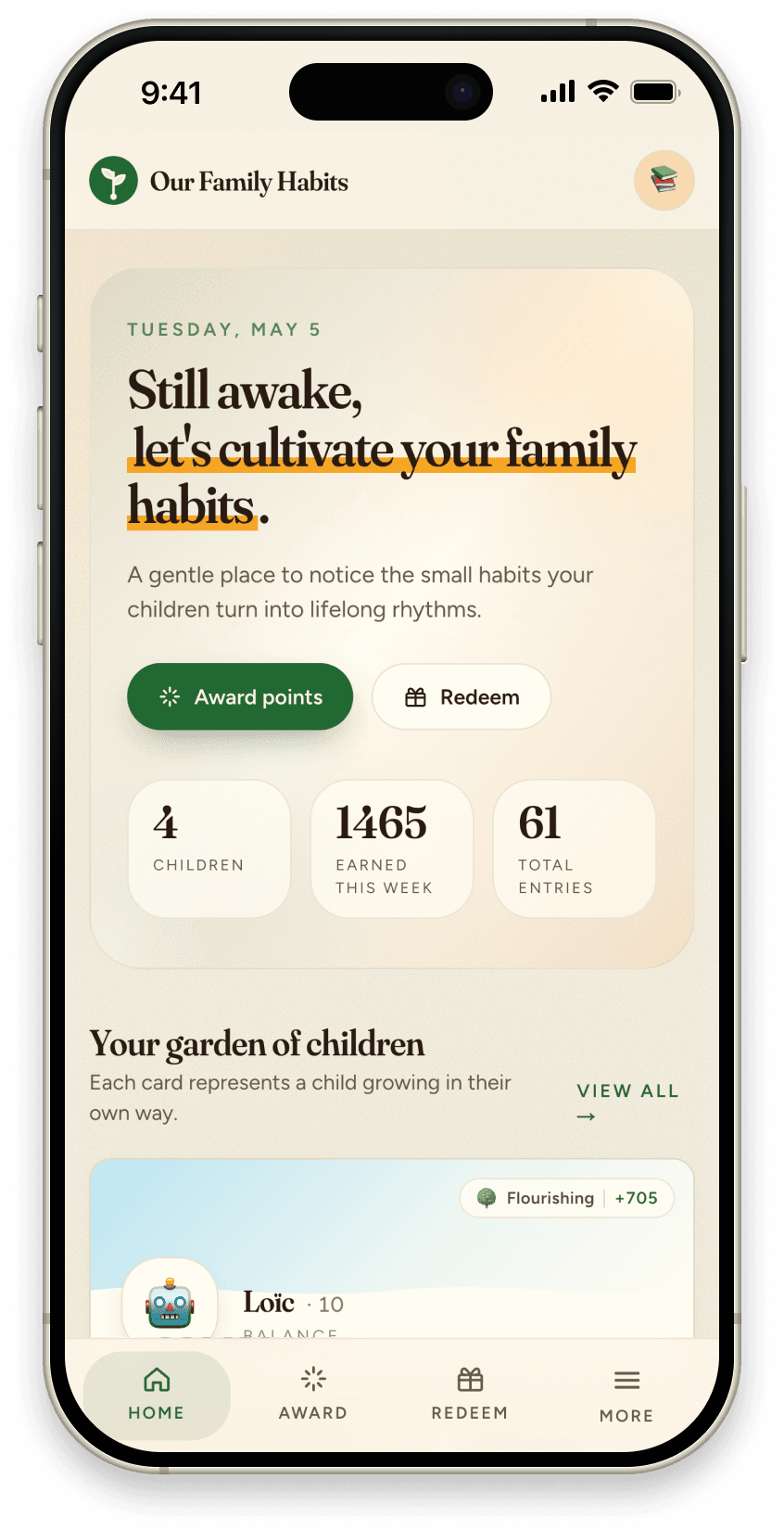
- Make it visible to everyone. This is the step families skip, and it's the one that makes it a family habit instead of your habit. A habit chart on the wall works. A shared tablet in the kitchen works better for more than two kids, because it tracks itself.
- Let the system give the feedback. Checkmarks, streaks, points toward something they care about—so the win comes from the board, not from your mood. (And so the miss is visible without you narrating it.)
- Hold it for six weeks before adding another. A family habit sticks slower than a personal one—you're waiting for the slowest adopter, not the fastest.
Do that once and something shifts that's bigger than the chore: your family learns that expectations can live outside of you. Every habit after the first one installs easier, because the family now has a place where habits live. That place—shared, visible, running the rhythms so a parent doesn't have to—is what we call a family operating system.
One step
Don't reorganize your household this week. Pick the one behavior you're tired of announcing, give it a trigger and a visible home, and let the system do the reminding for six weeks.
If you want the visible home ready-made—shared checklists your kids tap off, points and rewards that keep it warm past week three, and nothing for you to re-explain every morning—try Our Family Habits free. No card, no trial clock. Just one habit, moved out of your head.