How to get kids to do chores without nagging (stop being the reminder)
You're not a nag—you're the only reminder system your house has. That's the actual problem. Here's how to move the reminding out of your voice and into something kids can see, so chores happen without you narrating them.
By Jon Horton ·
At some point—usually mid-sentence, third repetition, kid still on the couch—you hear yourself. The tone. The rising pitch. The voice you swore you'd never use.
Nobody warns you that the worst part of nagging isn't that it doesn't work. It's that you start to hate the sound of your own voice in your own house.
So you search "how to get kids to do chores without nagging" and the internet hands you tips: make it fun! Use a timer! Offer choices! Some of those help for a week. None of them touch the actual problem.
Here's the actual problem.
You're not a nag. You're the reminder system.
In most homes, there is exactly one place the day's expectations live: a parent's head. Nobody else can see the list. So the only way the list reaches a kid is when the parent says it out loud.
Follow that to its conclusion. If your voice is the only delivery mechanism, then every expectation requires a verbal prompt. Multiply by three kids and six daily tasks and you're issuing eighteen prompts a day—before repeats. The repeats come because a spoken reminder evaporates on contact. There's nothing for a kid to look at, check, or come back to. Just a sound that already faded, from a parent who'll say it again anyway.
That's not a character flaw in you or defiance in them. It's architecture. The system you're running requires nagging to function. We've written about how that same architecture turns chores into daily power struggles—kids push on the rule because the rule is a person. Nagging is the other half of the same design flaw: the rule is a person, so the reminding is a person too.
You can't tip-and-trick your way out of it. You have to move the reminding somewhere else.
What actually replaces your voice
Not louder consequences. Not a better morning speech. A visible system—someplace outside your head where the expectations sit in plain sight, all day, without you saying anything.
Here's what that changes, concretely:
- The asking stops being personal. "Did you check your list?" is a different sentence than "Why haven't you fed the dog, I've asked you twice." One points at a system. The other points at you versus them.
- Kids can self-start. A kid can't act on a list he can't see. Put the list where he lives and some percentage of tasks start happening unprompted—not because he transformed, but because now he could.
- The miss is visible without commentary. An unchecked box says "not done yet" with no tone at all. The chart never sounds exasperated. That alone removes half the friction.
- You find out "done" without asking. Half of nagging is really status-checking—you can't see whether it happened, so you ask. A system that shows you kills those prompts outright.
How to set it up (four moves)
1. Get the list out of your head—completely. Every recurring expectation, written down, per kid. If it isn't in the system, you've agreed it doesn't exist. This is harder than it sounds; the invisible list is a habit too.
2. Anchor tasks to triggers, not to your prompts. "After breakfast," "before screens," "when homework ends." Event-anchored tasks remind themselves—the trigger happens every day whether you speak or not. This is the core of what makes something a real family habit instead of a parent-powered routine.
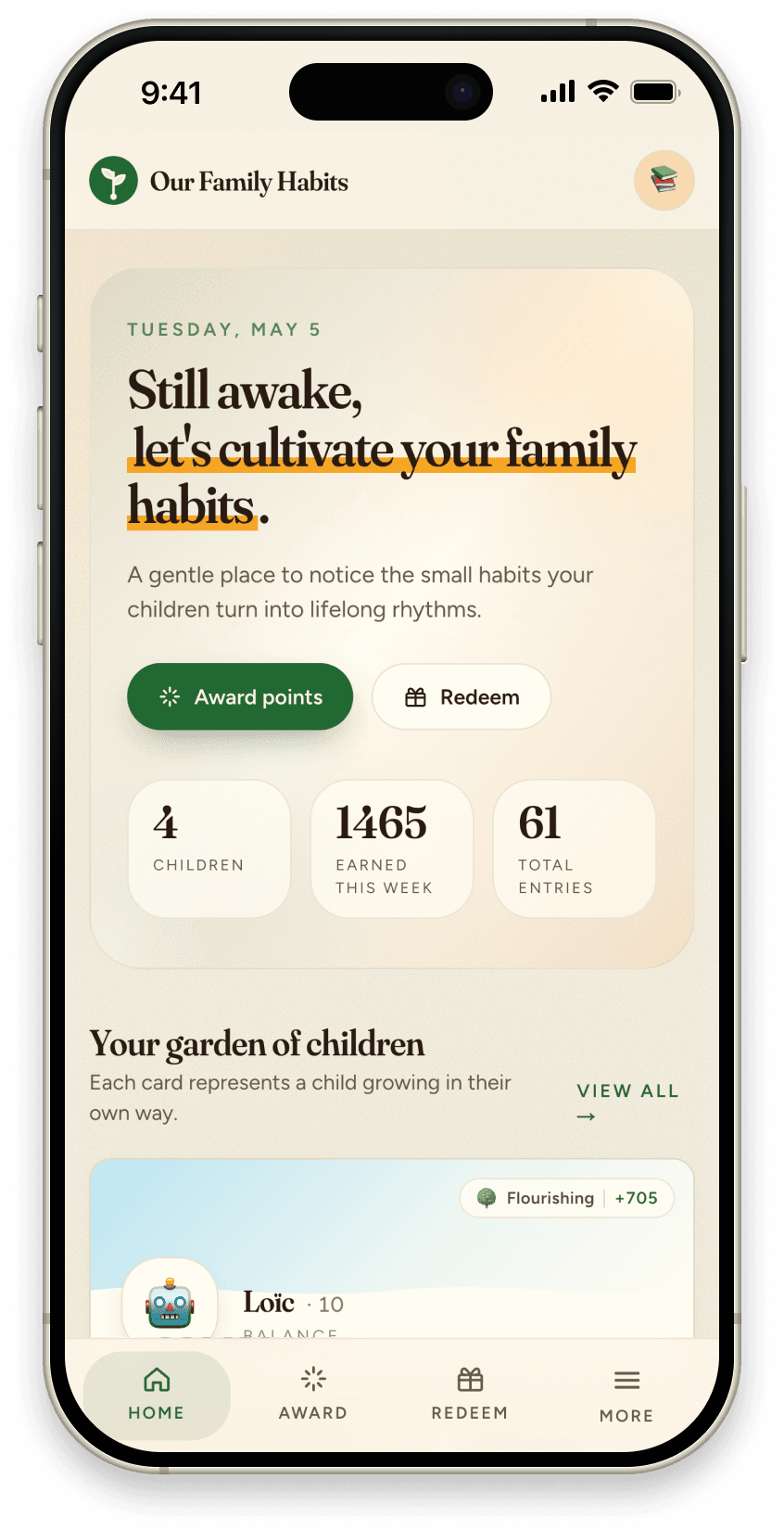
3. Put it where the family actually is. A paper chart on the fridge beats a list in your head. A shared tablet in the kitchen beats paper for more than two kids—kids tap their own tasks done, the display always shows what's left, and nobody has to find a marker. In Our Family Habits this is kiosk mode: one cheap tablet, every kid's day on it, no logins to fight over.
4. Let the system carry the follow-through. Checked tasks earn points toward rewards the kid actually wants—screen time, an outing, a privilege. A parent approval step keeps "done" honest without you inspecting in person. Now the loop closes without your voice anywhere in it: see task → do task → tap it → points land. You show up for the good part—the "look what I finished"—instead of the enforcement.
"But shouldn't they just remember on their own?"
Fair objection. Isn't a visible system a crutch?
You wouldn't be entirely off base—if the alternative were kids spontaneously developing executive function. But the real alternative, in every house I've seen, is you being the crutch. The question isn't crutch versus no crutch. It's whether the scaffolding is a chart on the wall or a mother's escalating voice.
And here's what the wall-chart version teaches that the voice version can't: kids learn to consult a system and act on it—check the board, do the thing, mark it done. That's the actual life skill. Adults who function well don't remember everything; they run calendars and lists. A kid working a visible routine is practicing exactly that, years early. A kid waiting to be nagged is practicing waiting to be nagged.
The reminding doesn't disappear. It gets promoted—from your voice to a system the whole family runs. That's the heart of a family operating system: the household's expectations, moved out of one exhausted head into shared, visible space.
One step
Tonight, write down every recurring thing you reminded anyone about today. That list is your current job description as Reminder-in-Chief.
Then pick a place for that list to live that isn't you. If you want it to run itself—visible on a kitchen tablet, tappable by a five-year-old, points flowing to rewards without you keeping score—start Our Family Habits free. No card needed. Your voice gets to go back to being just your voice.