Chore and Allowance Apps: How to Link Money to Chores Without the Wage Negotiation
A chore and allowance app can turn every request into 'what do I get?'—or it can teach real contribution. The difference isn't the app. It's whether money is the whole system or one option inside it.
By Jon Horton ·
My son asked me for two dollars to walk the dog last week. Not "can I," not "sure, Dad"—a rate quote, delivered flat, like he was bidding a job. I laughed, because it was funny. Then I stopped laughing, because I recognized exactly where that came from. We'd spent a stretch running a straight cash-per-chore system, and it had done precisely what you'd expect: taught him that everything asked of him in this house has a price, and if you don't name one, the request is negotiable.
That's the trap hiding inside most chore and allowance apps, and it's worth naming before you pick one. Link chores to money the wrong way and you don't build a helper—you build a contractor who bills by the task. Link them the right way, and allowance becomes one small, honest piece of a much bigger system: kids learning that this family runs on contribution, and money is one of several ways that contribution gets acknowledged.
What is a chore and allowance app?
A chore and allowance app tracks what a kid did around the house and connects it to a payout—usually real money, sometimes points that convert to money, occasionally both. Most fall into one of two camps. Money-first apps (BusyKid, Greenlight, FamZoo, RoosterMoney) are banking products with a chore list bolted on: the point is teaching kids to handle real cash, and chores exist mostly to justify the deposit. Character-first apps flip the emphasis—chores and habits are the point, and money is one reward among several a kid can choose to work toward.
Neither approach is wrong. But they teach different lessons about what a chore means, and most parents pick without realizing they're choosing.
Does paying kids per chore turn family life into a wage negotiation?
Yes, if that's the whole system. Pay-per-chore sounds simple—empty the trash, get fifty cents—but simplicity is the problem. A flat rate per task means every task now has a price tag attached, and a kid with a price tag in front of them will eventually ask what it is before they move. We've watched this play out the same way in enough houses to call it a pattern: "clean your room" stops being a family expectation and becomes an opening offer. Skip a chore because no rate was quoted, and you're not disciplining laziness—you're disciplining a kid who correctly noticed the system runs on payment and this particular ask didn't come with any.
The deeper issue is what it teaches about membership. Some things you do in a family because you live there—not because the going rate was acceptable. A kid who only moves for money hasn't learned to contribute. He's learned to invoice. We wrote about the research behind this in should you reward kids for chores: rewards aren't the enemy, but a flat, fixed payout for every single ask is the specific failure mode that trains a kid to treat family life as billable.
So should allowance be off the table entirely?
No—and that overcorrection causes its own problems. Kids do need practice handling real money: saving toward something, watching a balance grow, learning that spending forecloses other spending. Cutting allowance out entirely just moves that lesson later, to an age with higher stakes and less parental oversight.
The fix isn't "no money." It's moving money out of the driver's seat. We made this exact case about screen time in screen time as a reward for chores: the strongest currency in your house should never be the system, it should be one option inside the system. The same logic holds for allowance, arguably more so, because money doesn't wear off the way screen time or dessert does—it accumulates, it gets remembered, and it's the easiest reward to turn into the only reward without meaning to.
What does the "points in the middle" design actually look like?
Chores earn points. Points can be spent on a reward store a parent stocks—and allowance money is one shelf on that shelf, sitting next to a late bedtime, a one-on-one outing, extra screen time, or a friend sleepover. A kid choosing between cash and a movie night with Dad is making a real choice about what he values this week, not just cashing a check.
That small bit of indirection changes the lesson completely. Chores stop being "worth" a specific dollar amount and start being worth points—points a kid can direct wherever he wants. And critically: some contributions on the list don't earn anything at all, because setting the table or helping a sibling find their shoes is just what happens in this family, full stop. Not everything needs a price. The system should be able to hold both—paid effort and unpaid membership—without the two categories blurring into each other.
How do dedicated allowance apps compare to a points-based system?
Here's where the four money-first apps we mentioned actually sit, next to a points-based approach:
| App | Model | Real money / debit card | Points can buy non-money rewards | Kiosk / shared device | Free tier |
|---|---|---|---|---|---|
| Our Family Habits | Character-first, points-based | Optional—one reward among several | Yes | Yes | Yes |
| BusyKid | Money-first | Yes, plus stock investing | No | No | Trial only |
| Greenlight | Money-first | Yes, debit card | No | No | Trial only |
| FamZoo | Money-first | Yes, virtual family bank + prepaid cards | No | No | Trial only |
| RoosterMoney | Money-first | Yes, allowance + savings goals | No | No | Limited free |
BusyKid, Greenlight, FamZoo, and RoosterMoney are all genuinely good at the job they're built for: teaching kids to handle real money, with real accounts and real consequences. If that's the specific skill you're after, one of those four is likely the better tool than a points system—we'd say that even about our own product. Where they share a gap is the one we keep coming back to: chores exist to justify the payout, so the moment you want a chore to matter for a reason other than cash, the tooling doesn't follow you there. None of the four run a shared kitchen tablet, either—each assumes a kid has their own device or card, which doesn't fit a family running four or five kids off one counter.
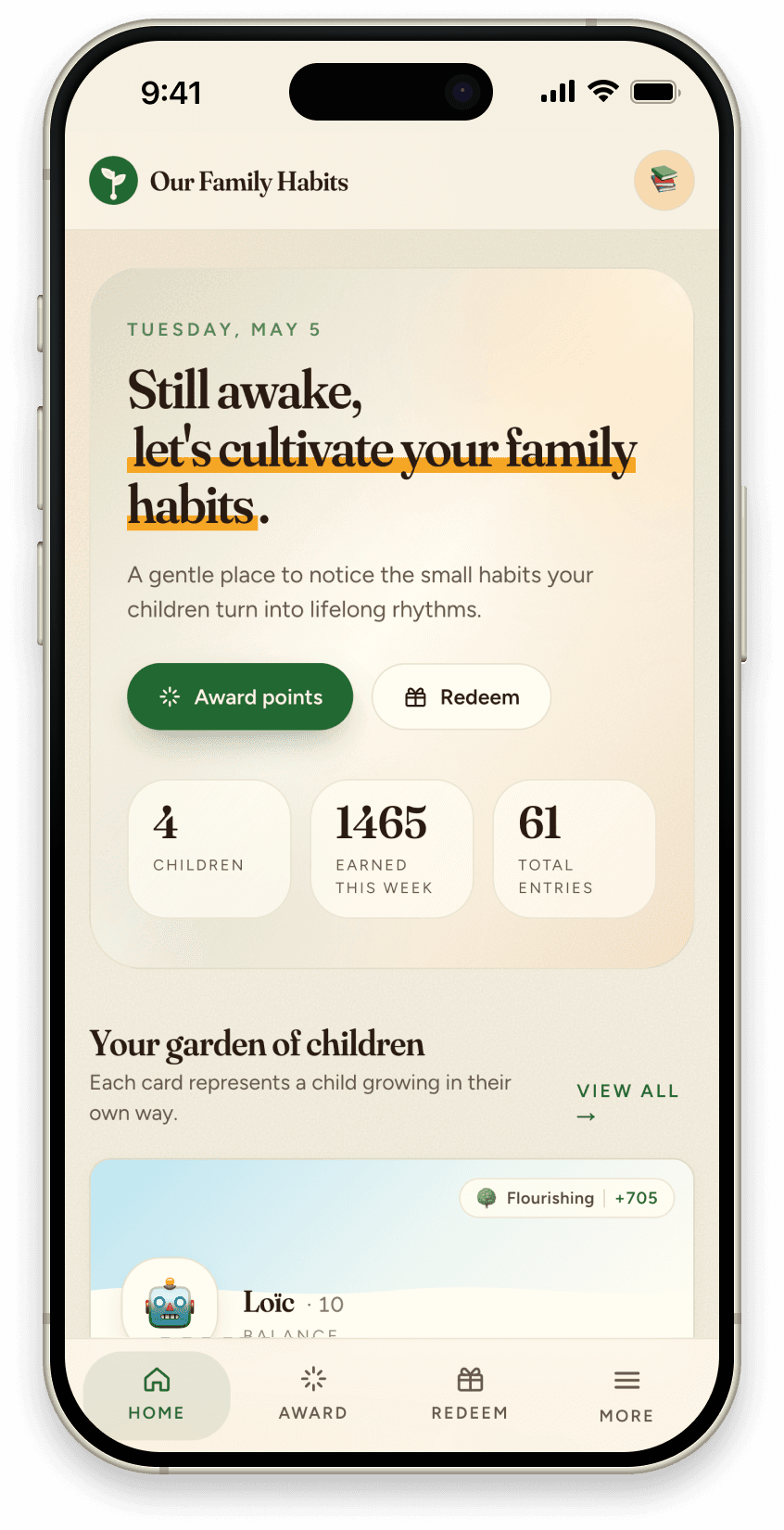
Not sure a points system is right for your house yet? Our Family Habits runs the whole loop free, no card required—chores, points, an approval queue, and a reward store you stock yourself, money included if you want it there.
What should parents actually build?
Decide what you want a chore to mean before you decide how to pay for it. If the honest goal is "teach my kid to manage a bank account," a dedicated allowance app is the more direct tool, and we'd point you there without hesitation. If the goal is closer to "teach my kid that this family runs on everybody pulling their weight, and money is one of the ways that gets recognized," you want money to be a shelf in the reward store, not the whole store.
Practically, that means: price chores in points, not dollars, set once and posted where everyone can see it. Stock the reward store with a real mix—money, but also privileges, outings, and time. Let some chores stay unpaid on purpose, because part of what you're teaching is that membership in a family isn't a transaction. And let the system hold the numbers, so a dispute over what got done doesn't become a dispute over what it was worth. A shared, visible system settles that argument before it starts—no mental math, no relitigating the rate at bedtime, no kid learning to bid for the dog walk instead of just doing it.
One step
Pick one chore your family currently pays flat cash for, and move it into a points system instead—with money as one option in the reward store, not the only one. Watch what your kid picks. If he still goes straight for the cash every time, that's useful information. If he starts choosing the outing instead, that's the system working. Our Family Habits runs this loop free, no card needed—you set the prices and stock the store, the system keeps the running tally.