Chore Apps for Tweens and Teens: Why the Cute Ones Quit Working at 12
Most chore apps for tweens and teens are built for seven-year-olds—cartoon avatars, gold stars, a chirpy mascot. A twelve-year-old reads that as babyish in about four seconds. Here's what actually keeps an older kid using a chore app: real responsibility, real currency, and a system that doesn't need you to referee it.
By Jon Horton ·
My twelve-year-old looked at a chore app on my phone once and said, "That's for babies." She wasn't being dramatic. She was right. A cartoon mascot was doing a little dance because she'd fed a virtual dragon by making her bed, and she is a person who has opinions about the news, not a person who wants to feed a dragon.
That's the trap with most chore apps for tweens and teens: they're chore apps for little kids, ported over with the same gold-star engine and a slightly older marketing photo. Somewhere around eleven or twelve, the cartoon avatars and sticker sounds stop reading as fun and start reading as condescending. The app becomes one more thing to eye-roll at, right next to "clean your room"—and now you've spent money on software that makes the nagging worse, not better.
We're a family of seven, several of them tweens and teens now, and we've watched this exact handoff happen more than once. What works at eight does not survive contact with twelve. Here's what does.
Why do kids stop using chore apps around age twelve?
Because the apps stop matching who the kid thinks they are. A seven-year-old is delighted by a badge. A twelve-year-old wants to know if the badge means anything—and it doesn't, so they clock it as fake almost instantly. Kids this age are hyper-alert to being talked down to; it's practically the whole developmental stage. A chore app for teenager use has to drop the game-layer and treat the chore like what it actually is: a real job with a real reason, done by someone who's capable of doing it without being cheered at.
This is also the age where a chore app for tweens quietly turns into a status symbol in reverse. A younger sibling still loving the dragon-feeding app while the oldest has aged out of it entirely is a pretty reliable signal that the tool was never built for the full age range—it was built for the youngest kid in the house and everyone else got dragged along.
What actually works for a chore app for tweens and teens?
Not more encouragement. More respect.
The tweens and teens who stick with a system aren't the ones getting the most confetti—they're the ones being treated like a capable member of the household instead of a project. That shows up in a few concrete ways:
- Real responsibilities, not busywork. Feeding the dog, running the dishwasher, handling their own laundry start to finish—jobs that matter to how the house actually runs, not "put five toys away" dressed up for a bigger kid.
- Real currency. Screen time, a later bedtime, cash toward something they're saving for, a say in the weekend plan. We've written a full breakdown of the most powerful one on the list—screen time as a reward for chores—and the short version holds here too: teenagers respond to leverage that's actually worth something to them, not points that only mean something to a six-year-old.
- No cartoon layer standing between the job and the credit. A chores app for teens should look like a tool, not a toy. A clean list, a clear point value, done.
How do you keep chores fair between siblings without playing referee?
This is the complaint we hear most from parents of tweens specifically: "he says he does more than his sister, and I genuinely don't know if that's true." At six, nobody's counting. At thirteen, everybody's counting, and the parent is expected to hold the whole scoreboard in their head and rule on every dispute.
That's a losing job. The fix isn't a fairer parent—it's a visible one. When every kid's chores, points, and history are on the same shared screen, "who does more" stops being a debate you referee and starts being a fact anyone can check. Nobody has to take your word for it, including you. That single change—the tally living outside your head, on a screen the whole family can read—is most of what we mean when we talk about a family operating system instead of a parent doing everything from memory.
Does a chore app for teens need parent approval, or is that surveillance?
Light approval, not surveillance. There's a real difference, and teenagers can tell which one they're getting.
Surveillance is a parent checking in on every task, asking follow-up questions, treating "done" as a claim to be interrogated. Light approval is a kid marking their own chore complete—they did the work, they own the checkmark—with a parent doing a quick glance-and-tap to confirm it actually happened. The kid runs their own list. The parent isn't absent, just not hovering.
That distinction matters more with a teenager than it did at seven, not less. A nine-year-old doesn't mind you double-checking everything. A fifteen-year-old experiences constant checking as a statement about whether you trust them, and they're not wrong to. A chore app for teens that puts the "mark it done" action in the kid's hands, with a parent's role reduced to a light confirm, is doing something bigger than tracking chores—it's practicing autonomy on purpose, in a low-stakes place, before the stakes get higher.
Why does nagging cost more with a teenager than it did at seven?
Because at seven, nagging is annoying. At fourteen, it's corrosive to the relationship itself. We've written at length about why nagging doesn't work, and the mechanism is the same at any age—the rule only exists in your head and your voice, so you're the one who has to keep saying it, and every repeat sounds like distrust to the kid hearing it. What changes with age is what's on the line. A younger kid tunes out the reminder. An older one starts avoiding you—the topic becomes a landmine, and you're the person standing next to it every day.
A shared system takes your voice out of the loop entirely. The chore list doesn't nag; it's just there, the same for everyone, visible without you saying a word. That's not a minor convenience at this age—it's often the difference between a house where chores are a daily fight and one where they're just Tuesday.
What should you look for in a chore app for a teenager?
Worth being blunt here: most chore apps built for kids simply age out. They're aimed at the six-to-ten range and never really built for a house where the oldest is fifteen and the youngest is six. Before you download anything, check for:
- No mandatory game skin. A dashboard, not a dragon.
- Currency options beyond stickers—screen time, privileges, money, all sitting in one reward system a teenager would actually value.
- Self-mark, parent-confirm—not full parent control, not full honor system.
- One shared view across siblings, so fairness is something anyone can check, not something you adjudicate.
- A shared-device or kiosk option, so a house with more than one kid isn't juggling five separate logins on five separate phones—worth reading if that's your setup, since a shared kiosk changes the whole dynamic.
One step
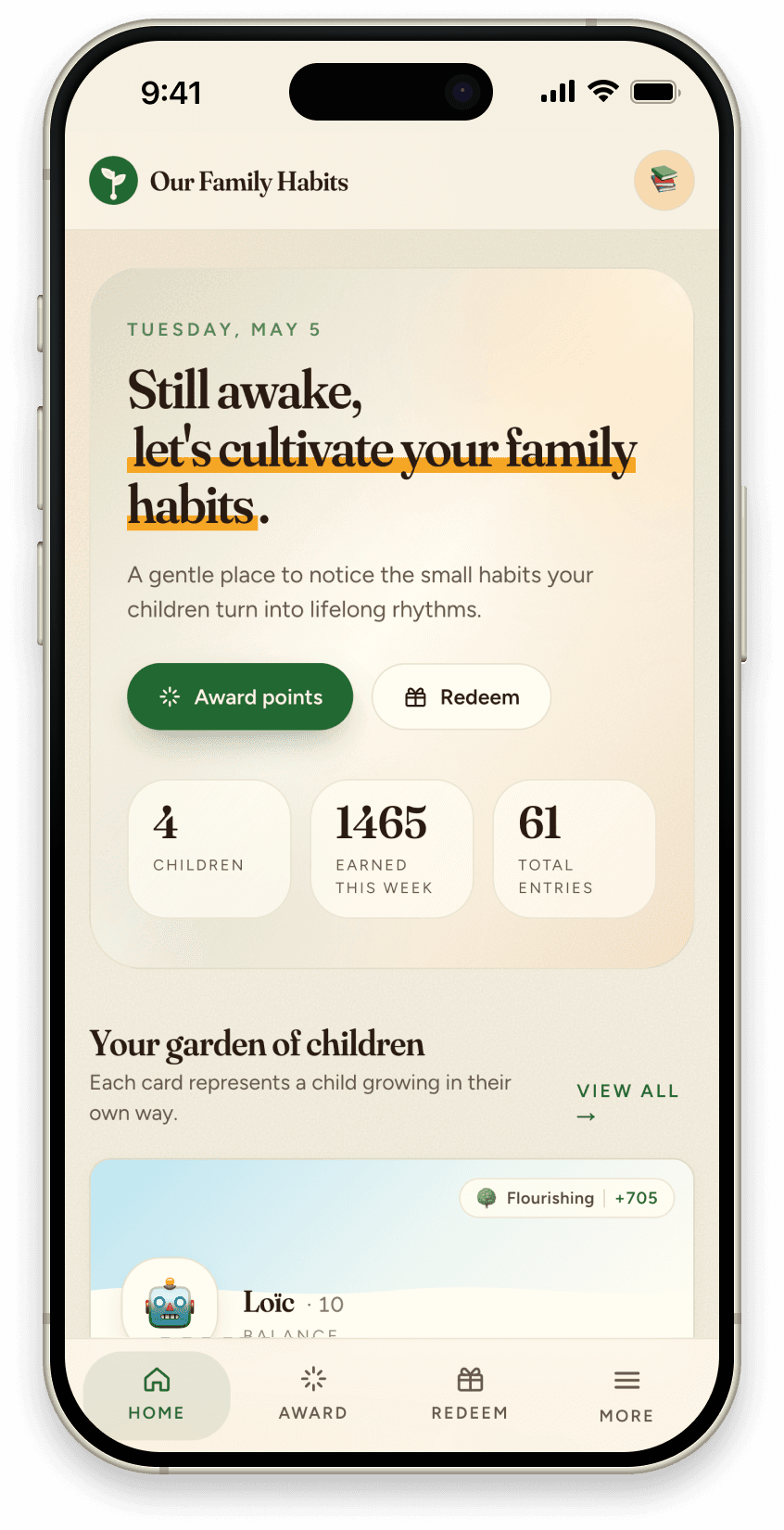
You don't need to overhaul the whole chore system this week. Pick one tween or teen in the house and move their chores off your memory and onto a shared list they mark done themselves—see what changes when nobody has to ask. Our Family Habits runs exactly that loop, with a reward store built for currency an older kid actually wants, free to start, no card needed.