Screen time as a reward for chores: smart currency or slow-motion mistake?
Should kids earn screen time by doing chores? It's the most powerful reward currency in your house—and the easiest to get wrong. Here's when the earn-your-screens loop works, where it quietly backfires, and how to run it so screens don't become the only reason anything happens.
By Jon Horton ·
Every parent discovers the same lever eventually.
You can offer a sticker, a dollar, dessert—polite interest at best. Mention screen time and suddenly the room got smaller and everyone's listening. It is, by a distance, the strongest currency circulating in a modern household.
So the obvious move is to spend it: chores earn screens. Whole apps are built on exactly that trade. And when parents ask us whether they should wire it up, they're usually braced for a lecture—either "screens are poison, never" or "whatever works, ship it."
Neither. The honest answer is that screen time is a powerful and dangerous reward currency—like most powerful things—and the difference between the families it helps and the families it backfires on is almost entirely in the setup.
Why it works so well
No mystery here. A reward only motivates if the kid actually wants it, and wanting is not evenly distributed. The behavioral-econ people would say screens have high reward salience; your nine-year-old would say Minecraft is the best thing in his life. Both are describing the same fact.
There's also a fairness logic kids intuitively accept: screens are a privilege, privileges sit downstream of contribution, and "work first, play after" is a rule they'll one day live under as adults with jobs. As house policies go, it's coherent and explainable in one sentence.
And practically: unlike cash, you control the supply. Unlike dessert, it isn't food. Unlike stickers, it doesn't wear off by age eight.
Where it quietly backfires
Four failure modes, in rough order of how often we see them:
1. Screens become the only reason anything happens. Run "no chores, no screens" long enough as the whole system and you teach a precise lesson: work is a coin you insert to make entertainment come out. Ask for anything without payment attached and you'll hear the question that tells you the lesson landed—"what do I get?" We wrote about this decay pattern in should you reward kids for chores: external rewards work; external rewards alone hollow out.
2. You've made screens more precious, not less. Restricting a thing raises its value. A strict earn-only regime can turn screen time into the household's gold standard—obsessed over, hoarded, negotiated—which is the opposite of the casual, bounded relationship with screens you were after.
3. The accounting falls on you. Somebody has to track minutes earned, minutes spent, and disputes between the two ("I did the trash yesterday, that's forty minutes!"). If that somebody is your memory, you've reinvented the nagging problem with math attached. The negotiation moves from whether the chore happened to what it was worth—same fight, new venue.
4. All-or-nothing enforcement fails Tuesday night. Kid skips chores, loses screens, has a meltdown at 7pm when you're at your weakest—and you fold, once. Now the rule is officially negotiable and everyone knows it.
How to run it well
The families who make this work all converge on the same few design choices:
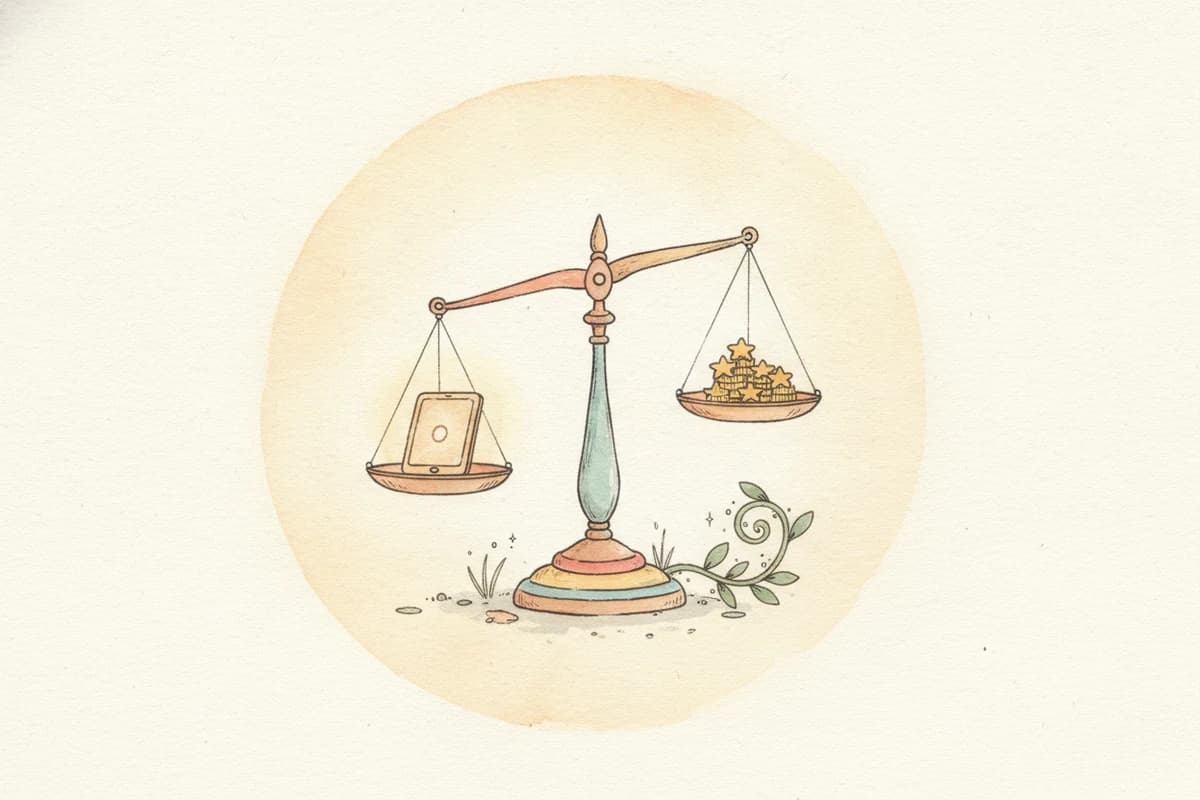
- Points in the middle, screens as one option. Chores earn points; points buy screen time—or a late bedtime, a one-on-one outing, a friend sleepover, cash if you choose. The moment screens are one shelf in a bigger reward store, failure modes 1 and 2 lose their teeth. Screens stop being the economy; they're just a popular product in it.
- A baseline and an earned layer. Many families keep a small unconditional allowance of screen time (it's also how kids relax, and you're not a vending machine) and gate the extra behind points. Calmer than all-or-nothing, and it survives Tuesday night.
- Let the system keep the books. Points earned, points spent, balance visible to the kid—tracked automatically, with a parent approval tap keeping "done" honest. No mental math, no relitigating rates at bedtime. The running tally settles disputes before they start.
- Price chores in advance, together. A posted rate—rooms are 10, dishes are 15—set once, calmly, beats improvised pricing under pressure. Kids accept rules; they contest rulings.
- Watch for the handoff. The long game is a kid who does his part because that's who he is in this family—the streak itself, the "look what I finished," the identity. Rewards are scaffolding for the first months, not the permanent engine. When you notice a habit running on its own, quietly stop paying for it and spend the points budget on the next one you're building. That handoff—reward-started, identity-sustained—is the whole architecture we build around.
So: should you?
If you're asking for a yes or no—yes, cautiously: screen time is too strong a motivator to leave unused, and "contribute first, consume after" is a house rule worth having. But wire it as points that can buy screens, not chores that unlock screens. The indirection looks small. It's everything.
One step
Don't build the whole economy this week. Pick three chores, price them in points, and stock a reward shelf with screen time plus two things that aren't screens. Watch which one your kid saves for—you'll learn something.
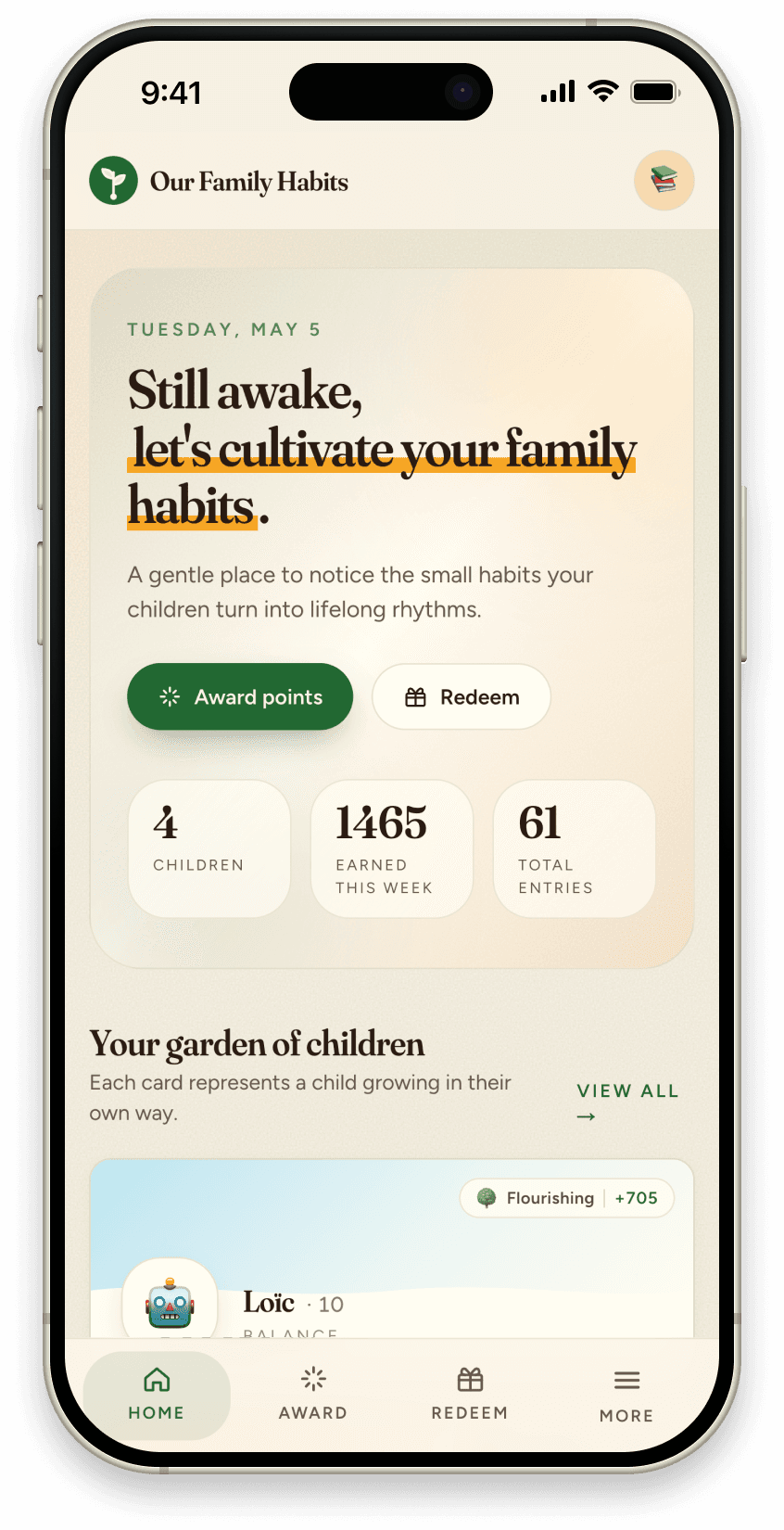
If you'd rather not be the bank, Our Family Habits runs the whole loop—tasks, points, approvals, a reward store you stock yourself—free, no card needed. You set the prices. The system keeps the books.