Should You Reward Kids for Doing Chores?
The intrinsic-motivation argument against rewarding chores is real — and mostly right, about the kind of reward most families use. Here's the honest answer, and what to build instead of a sticker chart or an allowance.
By Jon Horton ·
Somewhere around kid number three, I read the research on rewards and motivation and had a small crisis about it. The claim, roughly: pay a kid for a behavior and you don't just fail to build the habit — you can actively kill whatever internal motivation was already there. Offer a reward for something they'd have done anyway, and the reward becomes the reason. Take it away, and the behavior goes with it.
I believe that research. I also have five kids and a house that runs on somebody unloading the dishwasher. So the real question isn't whether rewards are bad. It's which rewards, structured which way, actually build something instead of renting a behavior for a week.
Should you reward kids for doing chores?
Yes, carefully — reward the pattern, not the individual chore, and let the reward change shape as the habit matures. The research on extrinsic motivation crowding out intrinsic motivation is real, but it describes a specific failure mode: a fixed, transactional payout for a task a kid could otherwise come to value on its own. It doesn't mean all structure is corrosive. It means the structure has to be doing more than bribery.
A one-time $5 for cleaning a room is the failure mode the research warns about — it teaches "I do this for money," full stop. A points system that a kid watches accumulate, that funds privileges they actually want, and that stays in place even on a bad week is a different mechanism. The dishwasher doesn't become "worth $5." It becomes part of what this family does, and the points are evidence of that, not the reason for it.
What's a good alternative to sticker charts?
A system where the reward's shape changes as the habit matures, instead of staying flat forever. We wrote the full mechanics of why stickers specifically decay in why sticker charts stop working — the short version is that a sticker earned today is worth exactly the same as a sticker earned three weeks ago, so there's no sense of growth, only repetition. Kids notice. By week three the chart is just a wall decoration nobody looks at.
The alternative isn't "no reward." It's a reward that starts concrete — points, small privileges — and gradually gets absorbed into identity: not "I get a point for reading" but "I'm a person who reads every day." A family habit tracker built around growth stages, not static checkmarks, does that hand-off on purpose instead of hoping it happens.
How do I get my kids to do chores without nagging?
Move the expectation out of your voice and onto something visible the whole family can see without you saying it out loud. Nagging isn't a discipline problem — it's an architecture problem. If the only place "make your bed" lives is inside your head, you're the alarm clock, every single day, and your kids are pushing against you specifically, not against the chore. We went deep on this in why is everything a fight: the parent who has to remember and repeat the rule becomes the rule, in a kid's mind, and the fight moves from "did I do it" to "why do you keep asking me."
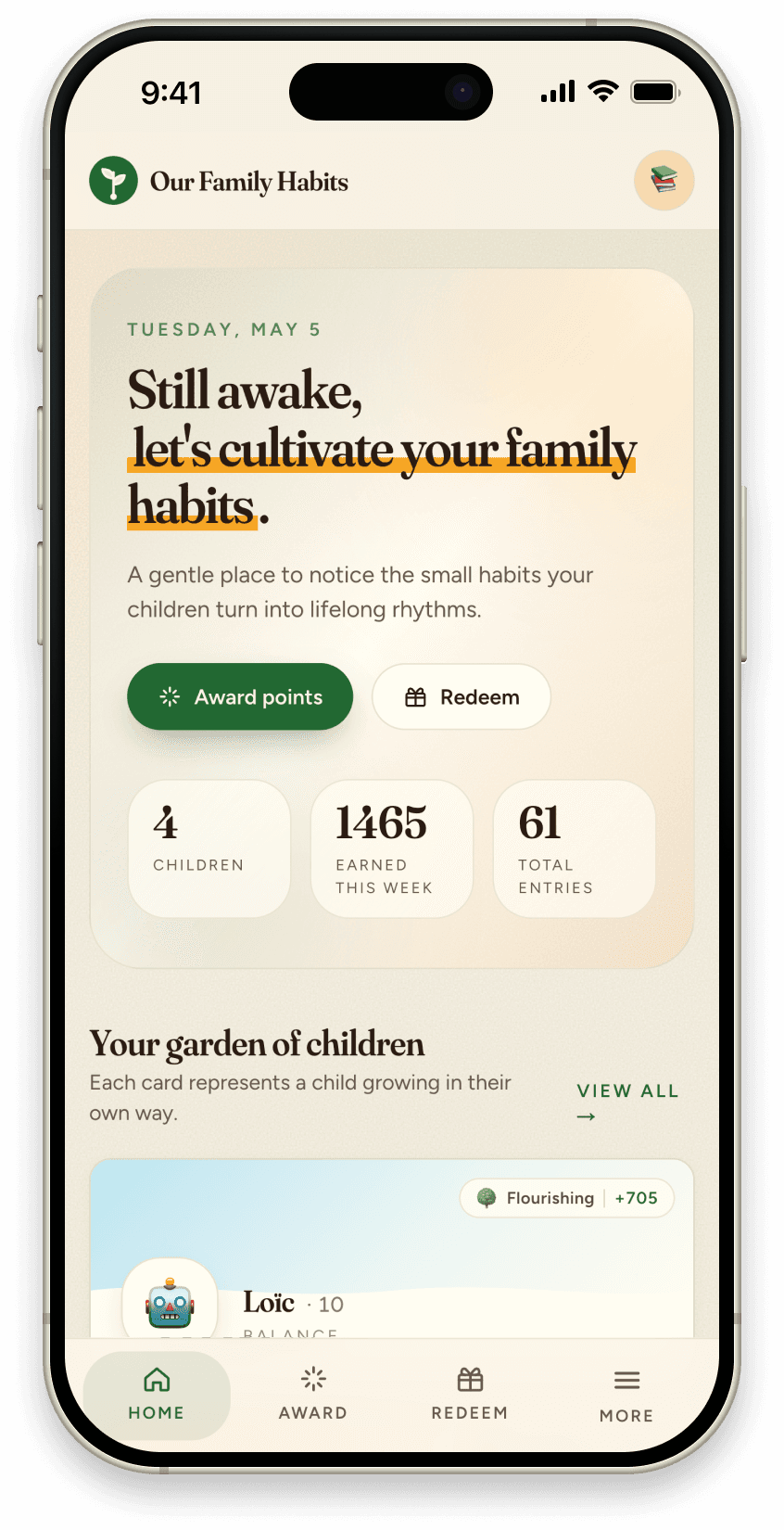
A shared kiosk — one tablet on the counter that shows what's expected without a parent saying it — takes the rule out of your mouth and puts it somewhere everyone can see. That single move does more for nagging than any reward structure.
Chore app vs. paper chore chart — which sticks?
The app, mainly because it can do something paper structurally can't: let the reward evolve without you redesigning the system every few weeks. A paper chart is either blank or full — there's no way to weight a hard day heavier than an easy one, no way to show accumulated effort instead of a binary yes/no, and no way to quietly raise the bar as your kid grows without literally printing a new chart. An app that tracks points, not just checkmarks, can carry all of that without you managing it by hand.
That said — paper works fine for some families, especially with one or two kids and a parent who has the bandwidth to keep redesigning it. The apps earn their keep once you're juggling three-plus kids and don't have time to be your own chart designer every month.
The honest middle ground
Here's what I'd actually tell a friend asking this over coffee: don't reward everything, and don't reward nothing.
Skip rewards entirely for things that are genuinely their own payoff — a finished puzzle, a good book, time with a sibling that went well. Layer a reward on top of the chores that are pure friction — nobody's intrinsically motivated to take out the trash, and pretending otherwise just delays the habit forming. And build the reward so it can fade. A points system where the points still exist but stop being the point — where your kid keeps tapping the tablet because that's just what happens in this house now — is the actual goal. Not "reward-free." Reward-transcended.
One step
If your chores currently run on cash-per-task, try swapping one chore this week to points instead of a flat payout, and watch whether anything changes in how your kid talks about it. If you want the whole system built for you instead of hand-rolled, Our Family Habits runs the points-and-rewards loop we've described here, with a free tier that doesn't need a card to try.