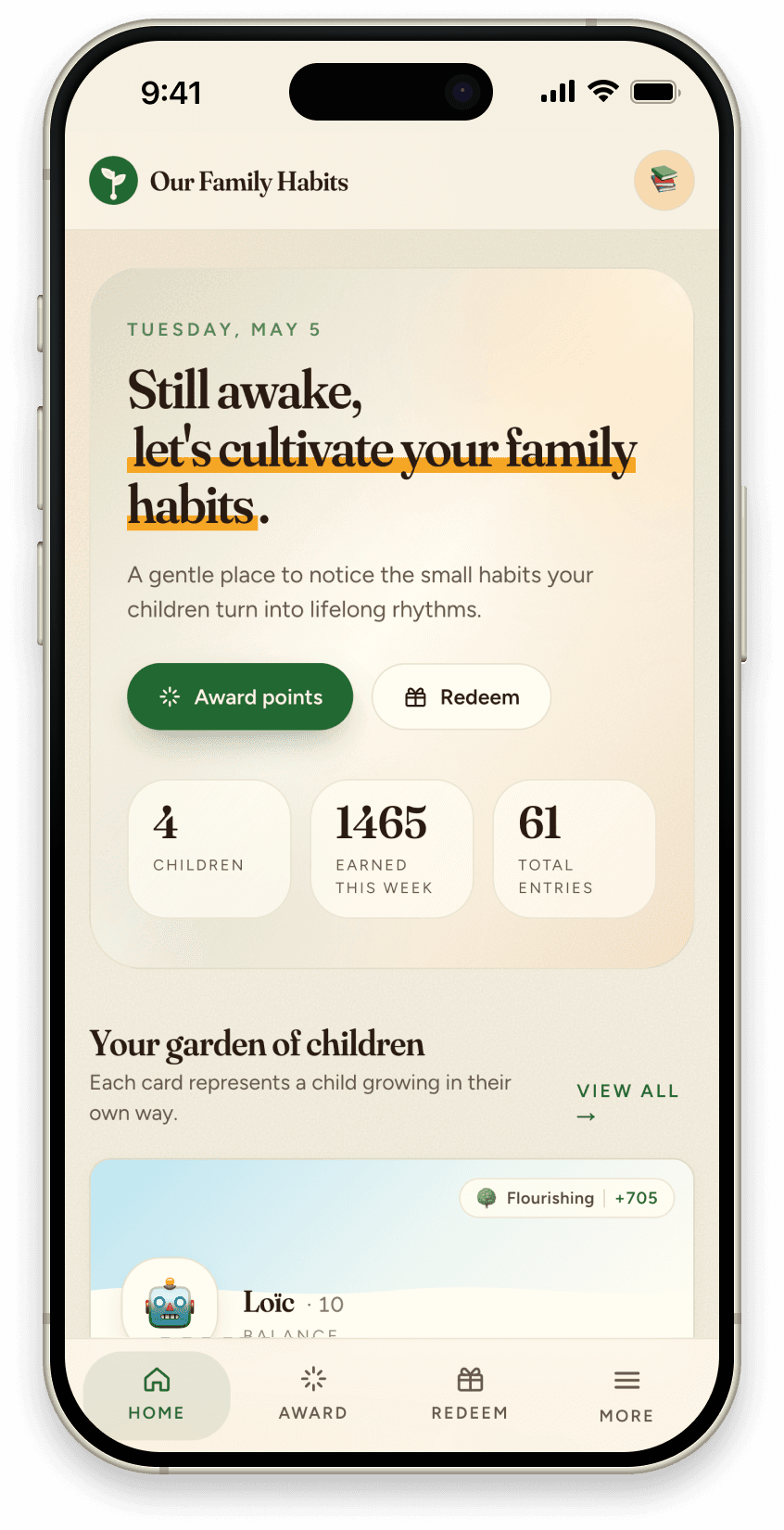
What is a family habit tracker? The shared system that ends the chore power struggle
A family habit tracker is a shared, visible place where the habits your family wants to build actually live — so the expectation stops living in you. Here's what it is, how it works, and why it turns nagging into ownership.
By Jon Horton ·

For a long time, the habits I wanted for my kids lived entirely in my head.
Brush your teeth. Feed the dog. Put your shoes where they go. Read for twenty minutes. None of it was written anywhere — it was just a list I carried around and had to keep saying out loud, all day, to whoever was in earshot. I was the reminder, the enforcer, and the scorekeeper, and I was all three at once, forever.
That's the thing a family habit tracker fixes. So let me answer the actual question first, plainly, and then tell you why it matters more than it sounds.
What a family habit tracker actually is
A family habit tracker is a shared, visible system where the daily habits your family is trying to build live outside of any one person's head — so the whole family can see them, run them, and track them together.
That's it. Instead of the expectations existing only in a parent's memory and voice, they live in one place everyone can look at. The habits you want to grow are written down. Doing them is marked. Progress is something a kid can watch climb, not something they have to take your word for.
A good one has three moving parts:
- The habits themselves — the small, repeated actions you actually want to cultivate. Not fifty of them. The handful that matter: the morning routine, the after-dinner reset, the things you're tired of asking for.
- A way to mark them done — a check, a tap, a point. Something that turns "did it" into a visible, agreed-upon fact instead of an argument.
- A shared view the whole family reads — ideally somewhere everyone passes, so the system is ambient. Not an app one parent checks in private, but a thing the house runs on.
You can build a crude version with a whiteboard and a marker. We built Our Family Habits to be the version that doesn't fade, doesn't get erased by a toddler, and keeps score fairly across a house full of kids. But the concept is older than any app: make the habits visible, and let the family — not the parent — carry them.
Why "tracker" undersells it
Here's where it gets interesting, and why I stopped calling ours just a tracker.
The word "tracker" makes it sound like a measurement tool — a way to record what already happened. And it does that. But the real work isn't in the recording. It's in what happens when the expectation moves out of you and into something everyone can see.
Because when the rule lives in your head, you are the rule. Every time you ask for something, you're not pointing at a standard — you're the standard, standing in the room, available to argue with. That's why chores turn into negotiations. A boundary made of a tired person is a boundary you can push against, out-wait, or out-argue. And kids will, because sometimes it works.
Move those same habits into a shared system and something changes. Now when your kid asks whose turn it is, you don't adjudicate from memory — you look. The daily actions don't have a mood. They say the same thing whether you slept eight hours or four. You stop being the rule and start being the person who backs the rule. We dug into that shift in why is everything a fight — the short version is that a family habit tracker isn't really tracking behavior. It's relocating authority, out of you and into a frame the whole family can trust.
That's why I think of it less as a tracker and more as a family operating system: the quiet layer underneath the house that decides what happens next, so nobody has to relitigate it every day.
How it turns nagging into ownership
The part that surprised me most was what it did to my kids — not their compliance, their sense of ownership.
When you're the tracker — the one holding all the habits in your head and calling them out — your kid is fundamentally passive. They wait to be told. They do it for you, or to get you off their back. The habit belongs to you, and they're just renting it under duress. That's the nagging loop, and it never ends, because you never actually hand anything over.
A visible system flips who owns the habit. The kid can see the day's actions themselves, check what's done, and watch their own effort add up. Finishing a job earns points; points buy rewards they picked out. The "why should I" question starts answering itself, because they can see what the work is building toward — and it's theirs to build. The motivation moves off of you convincing them and onto them wanting the thing.
And once effort is visible and tracked honestly, kids run into something they mostly get shielded from: consequences that aren't a punishment from a parent, just the natural math of their own choices. Skip the habit, the points don't come, the reward stays out of reach a little longer. Do it, and it climbs. Nobody's lecturing. The system just tells the truth, quietly, and a kid gets to feel the direct line between what they did and what followed. That's a lesson you can't nag into someone. They have to watch it happen to themselves — which is exactly what a shared tracker lets them do.
Fairness gets easier too. In a house with more than one kid, "it's not my turn" used to be my problem to settle from memory, which meant I was always the referee. With a running tally the kids can check themselves, the argument has nowhere to go. The answer isn't my word against theirs. It's just there.
The cycle that makes it stick
None of this works because tracking is magic. It works because visibility makes habits predictable, and predictability is what lets a habit actually take root.
The loop goes like this. The expectation lives in the system, so kids know what to expect. Because they know what to expect, they stop testing whether today is different. Because they stop testing, the days get smoother. Because the days get smoother, the habit sinks in — and a habit that's sunk in doesn't need a fight to start it. Your kid feeds the dog because that's what happens before breakfast, not because someone with enough authority finally made them.
That's the self-reinforcing part. Predictability builds the habit; the habit deepens the predictability. And the whole thing is aimed at something bigger than a tidy house: you're not just tracking chores, you're teaching a kid to run their own life inside a frame — a skill that outlasts every sticker chart and follows them out the door.
How to start one
You don't need our exact setup, and you don't need a house full of kids. The move is the same at any size: get the habits out of your head and into something your family can see.
- Pick three or four habits that genuinely matter in your house, and start small — one habit, awarded generously, then tune from there. A tracker with fifty things on it is just a new way to feel behind.
- Put it somewhere everyone passes, so the expectation is ambient instead of living in your voice. Our 10-minute kiosk guide covers turning a spare tablet into that shared hub.
- Let effort land somewhere a kid can watch it climb — points, progress, a reward they chose — so the system is what motivates and settles disputes, not you, again, at the end of a long day.
A family habit tracker isn't a chart you have to remember to update. At its best it's the thing that remembers for you — so the habits you want for your kids stop being a speech you give and become something the whole family just runs.
You can start with Our Family Habits free and build that frame once — so the next time a habit needs doing, it isn't a fight, and it isn't your voice. It's just what comes next.