The Best Chore Apps for Kids: What Actually Works at Every Age
Not every chore app for kids works for every kid. Here's what actually holds up at 5, at 9, and at 13—plus an honest answer on whether gamified chore apps like Habitica are worth it.
By Jon Horton ·
My five-year-old can't read yet, so a chore list with words on it is furniture to her—she needs pictures she can tap. My nine-year-old reads fine but doesn't care about a checklist; he cares about the number going up. My thirteen-year-old doesn't want an app at all—he wants to be treated like someone who doesn't need one, which is its own problem for another day.
Three kids, three completely different relationships with the same idea. That's the thing most "best chore apps for kids" roundups skip: they review the app like there's one kid using it. There isn't. If you've got more than one child, or you're picking an app that has to serve your kid at seven and still make sense at eleven, age is the whole decision—more than price, more than the badge design, more than which app your friend swears by.
What is the best chore app for kids?
The best chore app for kids is the one that matches how that kid actually operates at that age—a five-year-old needs pictures and taps, not text; an eight-to-eleven-year-old needs points that turn into something real; a teenager needs almost the opposite of an app. There's no single winner across all three, which is exactly why so many families try one app, watch it work for one kid and flop for another, and conclude the whole category is broken. It isn't broken. It's mismatched.
Ages 4–7: taps and pictures, not reading
At this age, the app isn't competing with other chore apps—it's competing with your kid's ability to read a sentence and remember what it meant. Anything that leans on text, menus, or a login screen loses before the chore even starts.
What actually works:
- Icons over words. A picture of a toothbrush beats the word "brush teeth" for a kid who's still sounding out letters.
- One tap, done. No multi-step flow, no typing, no navigating between screens.
- A shared device, not their own login. Almost no five-year-old is managing a personal phone. They're walking up to a tablet on the counter.
- Immediate, visible feedback. A checkmark, a fill-in bar, a sound—something that confirms it happened without needing a parent to explain it.
App marketing at this age tends to sell "engagement"—mascots, animations, mini-games. What actually matters is closer to the opposite: can the kid do the whole loop, unassisted, in under ten seconds? That's the real test, not how cute the onboarding is.
Ages 8–11: this is where points and rewards land hardest
Somewhere around eight, kids start understanding a system as a system—that effort now connects to something later, that a number can be saved, spent, or lost. This is the age band where points-based chore apps do their best work, and where the design choices matter most.
A few things separate the apps that hold up from the ones that fade by month two:
- Points that mean something. Vague "great job!" praise stops landing around here. A number that visibly accumulates toward a real reward does more.
- Rewards that aren't only money. Some families want allowance; plenty want screen time, a privilege, or a family outing to be on the table too. We wrote about running screen time specifically as a reward currency in screen time as a reward for chores—it's the strongest lever at this age, and also the easiest to overuse.
- Parent approval, not the honor system. An eight-year-old will absolutely mark "cleaned my room" done from across the house. An approval step before points land keeps the system honest without turning into a fight.
- A shared picture the kid can check themselves. Kids this age like knowing where they stand. A running tally they can glance at removes the "wait, how many points do I have" question that otherwise lands on you six times a day.
This is also the age where the reward, left running forever on its own, starts to hollow out the habit underneath it. We go deeper on that pattern—and when to start easing off the reward—in should you reward kids for chores.
Ages 12 and up: a different problem
Past twelve, the friction usually isn't "which app"—it's whether a chore app is even the right tool anymore. Teenagers respond to autonomy and real stakes more than they respond to points on a screen. That's a genuinely different problem than what a five- or nine-year-old needs, and it deserves its own answer rather than a rushed paragraph here.
Do gamified chore apps work?
Search around and you'll find plenty of gamified options—apps that turn chores into a quest, a virtual pet to feed, an RPG character to level up. Habitica is the best-known example, and "Habitica for kids" is a common search for exactly this reason: parents want the game-layer engagement without the app being built for adults.
Here's the honest answer: games work, for a while. A virtual pet or a quest map genuinely gets a reluctant kid to engage—sometimes faster than anything else on this list. But the novelty decays the same way a sticker chart's novelty decays. We've written about why that pattern is so predictable in why sticker charts stop working—the short version is that a reward mechanism that never changes shape stops registering as a reward by week three. A game world is just a more elaborate version of the same sticker chart, and it eventually asks to be fed like one: now there's a pet to keep happy on top of the actual chore.
Habitica itself proves the ceiling on this approach for younger kids—it's genuinely fun for teens and RPG-minded adults, but there's no parent approval, no real multi-kid framing, and most kids under twelve find the menus overwhelming rather than motivating.
The alternative isn't "no reward"—it's a calm, visible system instead of a game that has to keep manufacturing excitement to hold attention. A kid checking off a real chore and watching a real reward accumulate doesn't need the app to entertain them; the actual progress is the draw. That's the bet a quieter system makes, and it's the one that tends to outlast the game apps once the pet stops being novel.
What if you have more than one kid?
This is where age-band shopping runs into a second problem: a five-year-old, a nine-year-old, and a thirteen-year-old in the same house can't each run their own separate chore app without you becoming the one syncing five systems in your head. That's not a chore app problem anymore—that's a second job.
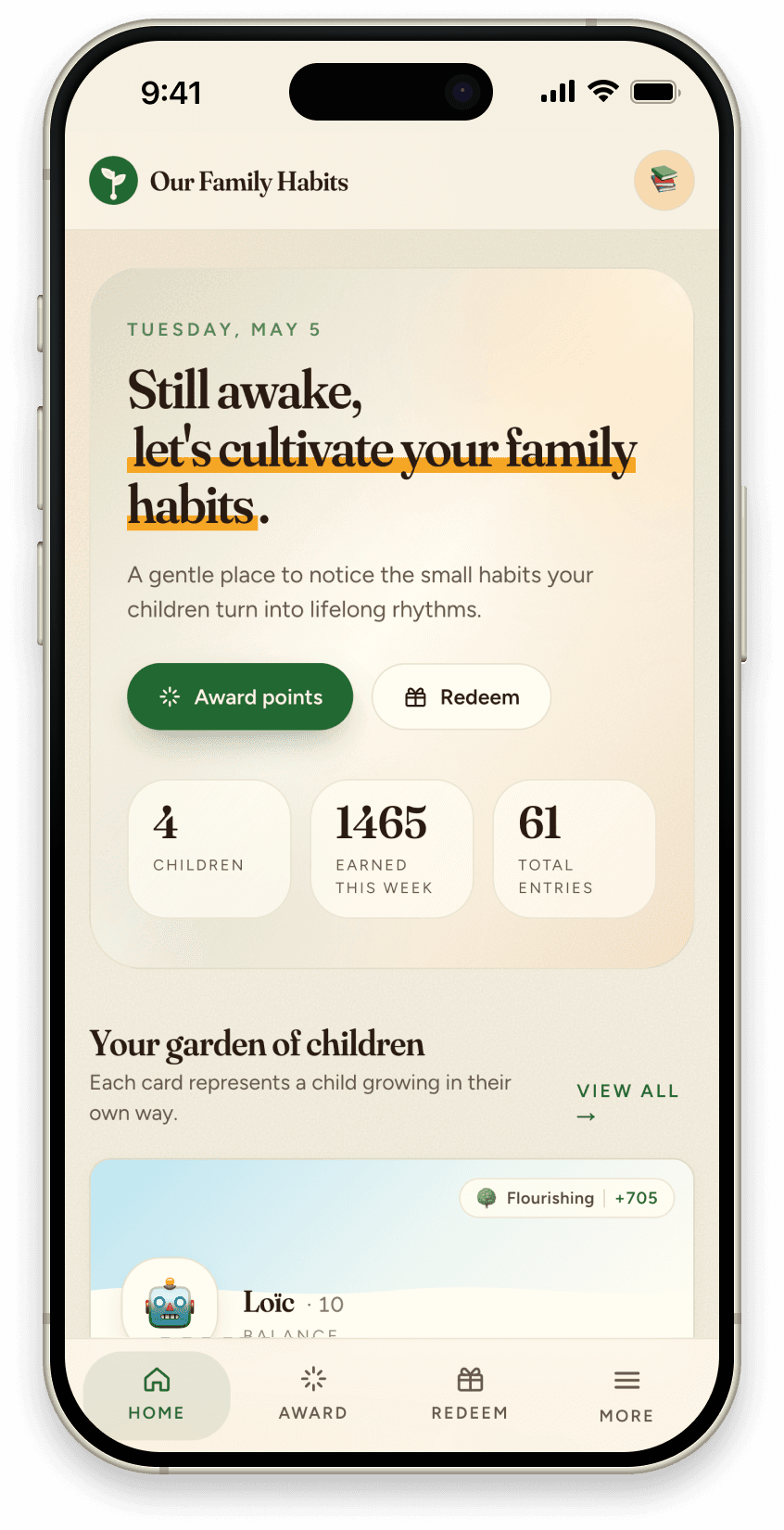
What multi-kid families actually need is one shared system, not five kid-specific apps bolted together. A single kiosk on the kitchen counter where a five-year-old taps a picture, a nine-year-old checks their points, and everyone's daily actions live on the same shared screen—built for households with more than one kid instead of retrofitted from a single-child design. That's the differentiator that age-band comparisons alone won't show you: the best chore app for your kid stops mattering if it can't also be the best chore app for their siblings, on the same device, without five logins.
Comparison: chore apps by what they need from a kid
| App | Best age fit | Works on a shared device | Needs reading | Game layer |
|---|---|---|---|---|
| Our Family Habits | 4 and up | Yes | No—icons and taps | No |
| OurHome | 8 and up | No | Yes | No |
| Joon | 6–12 | No | Some | Yes—pet and quests |
| Goally | Any (hardware-based) | Tablet hardware, one kid | No | No |
| Habitica | 13+, RPG-minded teens and adults | No | Yes | Yes—full RPG |
This list is deliberately narrow—kid capability at each age, not the fuller feature and pricing comparison. For the parent-facing side of the decision—allowance models, kiosk mode, free tiers, and where each app fits a family budget—see the best chore apps for families, where we tested the wider field including the allowance-first apps this list leaves out.
Want the shared-device version for a house with more than one age group on it? Start with Our Family Habits free—no card, and it's built to work for the five-year-old and the nine-year-old on the same tablet.
How to pick, by age
- Preschool to early elementary? Pictures, one tap, no login—anything that assumes reading will lose them.
- Elementary, roughly 8–11? Points that build toward a real reward, plus a parent approval step so the system stays honest.
- Middle school and up? Reconsider whether an app is even the answer before picking one.
- More than one kid spanning those ranges? Stop shopping per kid and shop for one shared system the whole family can read at a glance.
One step
Don't try to solve all three age bands in one afternoon. Pick the age band that's causing the most friction in your house right now—probably the 8–11 window, where the points fight lives—and set up just that. If a shared kiosk sounds like the missing piece, Our Family Habits is free to start, no card needed, and it's built so a picture-tapping five-year-old and a point-tracking nine-year-old can run it side by side.