The Best Chore Chart App for Families—and Why the Paper One Died
You searched for the best chore chart app for families because the fridge chart stopped working. Here's why paper charts always die, why a prettier digital version doesn't fix it on its own, and what actually has to change.
By Jon Horton ·
There's a chart on our fridge right now. Laminated, five columns, a dry-erase marker tied to it with kitchen string. Half the boxes haven't been checked in three weeks. Nobody decided to quit—it just went quiet, the way these things do, until one day you notice the marker's dried out and nobody's mentioned it.
If you're searching for the best chore chart app for families, you've probably already lived this exact moment. The chart worked great for about ten days. Then it didn't. And the question you're actually asking isn't "which app has the nicest chart"—it's "why does this keep happening, and is there a version that doesn't."
Why did the paper chore chart stop working?
Because the chart was never the system. You were.
The chart is a display—a list of boxes on the wall. The actual system was running somewhere else the whole time: in your head, as the thing you remembered to check, the thing you reminded someone about, the thing you decided counted as "done" or didn't. The paper just showed the output. When you got busy, sick, or simply tired of being the one who noticed, the display kept hanging there—but nothing behind it was running anymore.
That's not a discipline problem, and it's not really about the chart's design. It's an architecture problem: one person is the single point of failure for a rule everyone's supposed to be following. Swap the laminated sheet for a nicer one, buy better markers, color-code the columns—none of it touches the actual weak point, which is that the whole thing depends on one adult's attention holding steady every single day, forever. Nobody's attention does that.
We've written about the psychology of that specific failure mode in why sticker charts stop working—this piece is about what to do next, once you already know paper isn't coming back.
What is the best chore chart app for families?
The best chore chart app for families is the one that stops depending on a parent's memory to run—where a kid can see what's expected without being told, mark it done themselves, and a parent's only job is a quick approval, not the whole operation. Judge any chore chart app for family use against three things:
- Visible without you. Can a kid check the chart without asking you what's on it?
- Self-service. Can they mark something done without you writing it down?
- Honest without your memory. Does something other than your recall confirm it actually happened?
Most apps that call themselves a "digital chore chart app" nail the first one—the chart looks great on a screen—and quietly skip the other two. That's the gap that matters.
Is a digital chore chart app actually different from paper?
Only if it moves work off you. A screen that just displays the same list, that you still have to update, still have to remember to check, still have to argue about at bedtime—that's a nicer-looking version of the same failure. It'll die the same way the laminated one did, just with better fonts.
The apps worth comparing are the ones where the system runs on the device, not just the chart: kids see what's expected, tap it done themselves, and something other than a parent's memory settles disputes. That's a narrower bar than "has a chore list," and it's the reason so many apps that look identical in a screenshot behave completely differently by week three.
How do the chore chart apps compare?
| App | Chart runs itself | Shared/kiosk tablet | Parent approval | Free tier |
|---|---|---|---|---|
| Our Family Habits | Yes | Yes | Yes | Yes |
| OurHome | Partial—no kiosk mode | No | Yes | Yes |
| Cozi | No—calendar/to-do, not a chore engine | No | No | Yes |
| Goally | Yes, on dedicated hardware | Tablet (hardware) | Yes | Hardware-based |
| Habitica | Partial—built for one user | No | No | Yes |
OurHome is genuinely free and multi-kid, but there's no kiosk mode—younger kids who can't type a password can't log themselves in, so the remembering drifts back to a parent. Cozi's to-do list looks chart-like but has no parent approval and no rewards; it was built to stop double-booked Saturdays, not to run a chore system—we cover that trade-off fully in our Cozi comparison. Goally is closer to hardware than software, built around one kid's visual routines rather than a shared family chart. Habitica is a habit tracker dressed as an RPG—deep for the right user, but it wasn't built for a family sharing one chart.
Want the fuller field, including the allowance and banking apps? We ranked the whole category, chore-chart apps and money-first apps both, in the best chore apps for families.
If your fridge chart died because nobody but you was keeping it running, start with Our Family Habits free and see whether the chart survives without you holding it up.
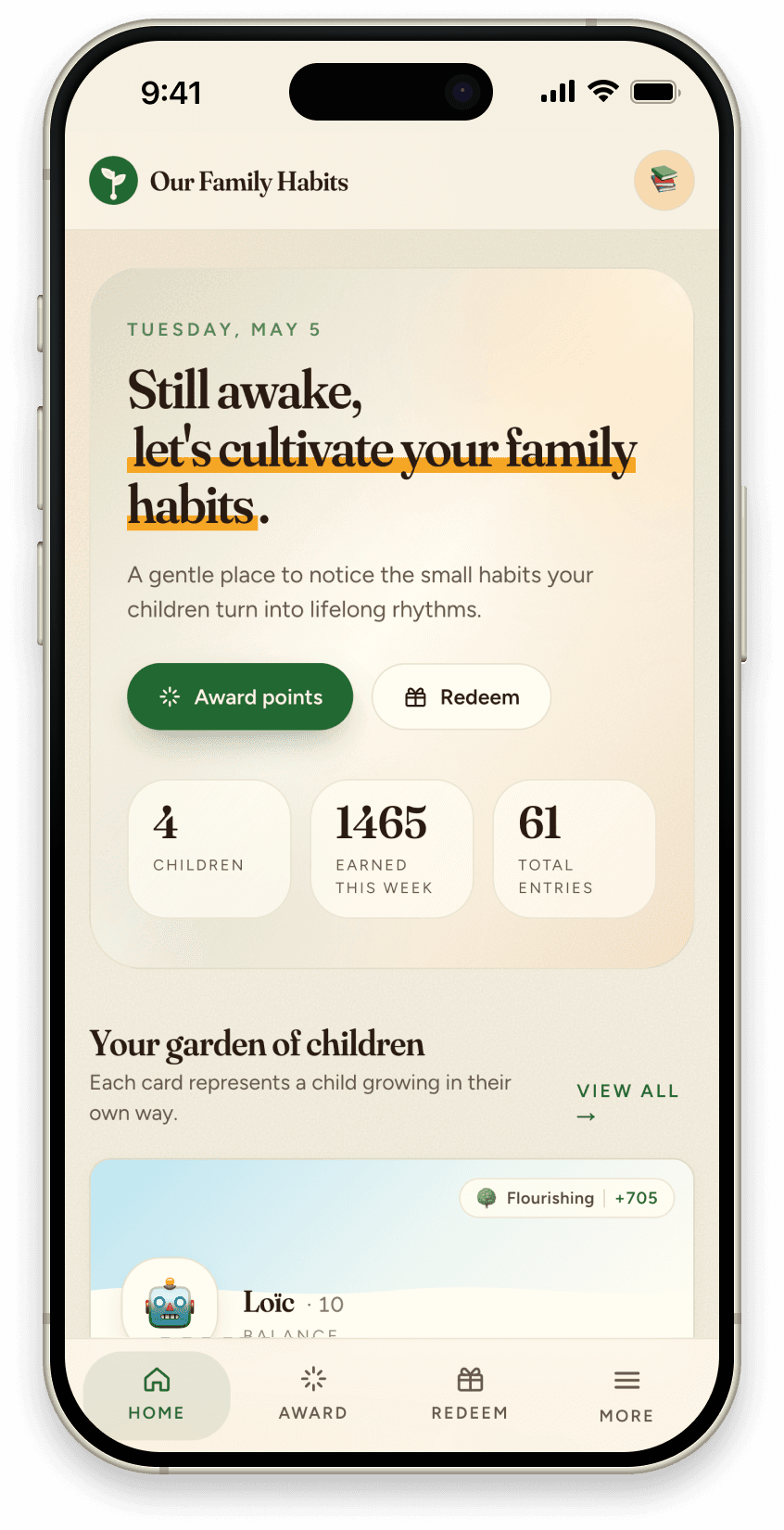
How does Our Family Habits work as a chore chart that runs itself?
We built this after watching our own laminated chart go quiet more than once. A parent sets the daily actions that matter—chores, but also reading, practice, kindness to a sibling—once, not every morning. It lives on a kitchen kiosk: one tablet on the counter, no logins for little kids, just names and today's list. A kid taps a chore done. A parent gets a quick approval to confirm it actually happened—the honesty check paper never had. Points roll into a reward store you stock yourself, and the running tally settles "I did that yesterday" arguments instead of you having to remember who's right.
That's the actual difference between a chore chart and a chore chart app for families that works: not a nicer display, but the display finally running on something other than you.
Is there a chore chart app that's free?
Yes—several, including ours. Our Family Habits is free to start, no card required. OurHome and Cozi are also free, with the trade-offs above. Where the paid tiers show up is mostly in the allowance-and-banking apps (BusyKid, Greenlight, FamZoo), which solve a different problem—real money management—and aren't really chore charts so much as banking apps with chores attached. If a chore chart app free of subscription tiers is the whole requirement, OurHome and Our Family Habits both clear that bar; the difference is what happens once the free trial-of-novelty wears off and someone has to keep the chart honest.
One step
You don't need to migrate your whole family system this week. Take the chores already on your dead fridge chart, load them into a kiosk-style app once, and watch whether they run for a week without you checking. If they do, you've found the fix. If they don't, you've learned something real about where the system actually breaks. Our Family Habits is free to try—no card, no trial clock—start here and let the chart hold itself up for once.