Summer routines that survive when school structure disappears
School gives the day its skeleton. When it goes, June feels free for about a week — then the bickering starts. Here's how to keep a light rhythm without turning summer into a second classroom.
By Jon Horton ·

The first week of summer is wonderful. The second week, somewhere around 10am, a child appears in the kitchen and announces — with real grievance — that there is nothing to do. By the third week the screens have quietly taken over and bedtime has drifted an hour later than anyone agreed to.
This isn't a discipline problem. It's a structure problem. The school year hands you a skeleton: a wake-up time, a leaving time, a rhythm of subjects and breaks and a hard stop at the end. Pull the skeleton out and the day doesn't become free — it becomes shapeless. Kids feel that shapelessness as boredom, and boredom is loud.
The fix isn't to rebuild school at home. It's to give summer just enough spine to stand up on its own.
Keep three anchors, drop the rest
You don't need a schedule. You need a few fixed points the day can hang off of. Three is plenty:
- A morning anchor — the things that happen before the day opens up. Get dressed, eat, make the bed, one chunk of reading. Done by a loose time, not a strict one.
- A midday anchor — lunch, plus a quiet hour. Even big kids do well with a flat stretch where nobody's screen is on and nobody's being entertained.
- An evening anchor — the wind-down. Tidy the common spaces, something calm, bed roughly when bed normally happens.
Between the anchors, the day is genuinely free. That's the point. Kids handle wide-open time much better when it's bounded by something predictable on either side. The anchors aren't the cage; they're the fence that makes the field safe to run in.
Make the morning list the kid's job, not yours
The single thing that kept our summers from sliding was moving the morning list off my shoulders and onto theirs. Not "do your jobs" repeated six times — an actual list they can see and work through without me standing over it.
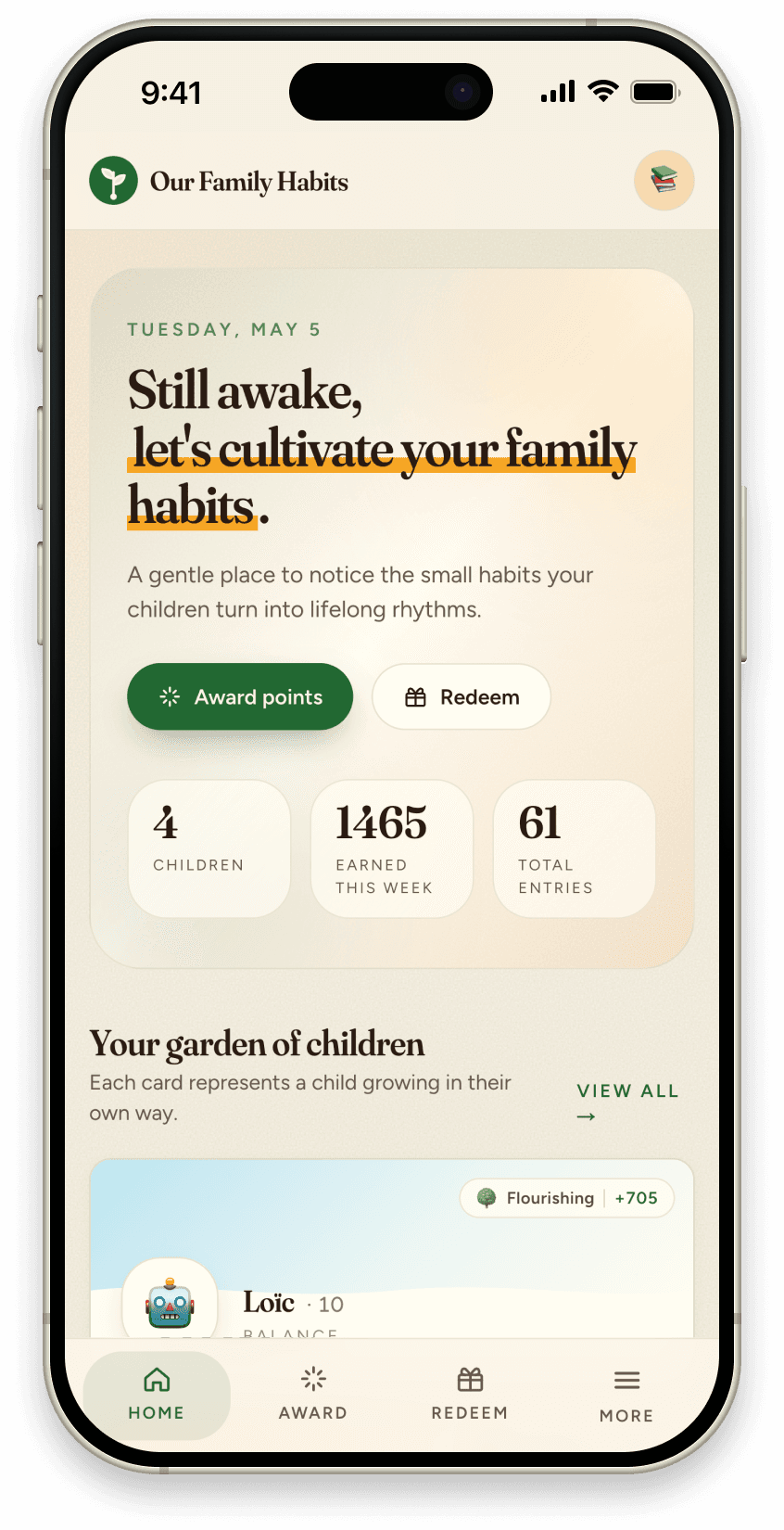
This is where a shared board earns its keep. Inside Our Family Habits, the morning anchor is just a handful of actions a kid can check off themselves: dressed, bed, breakfast cleared, twenty minutes of reading. They tap them as they go. I'm not the foreman; the list is. By mid-July they're running the whole opening of the day before I've finished my coffee, and the nagging that usually defines summer mornings mostly evaporates.
If you've never set up a shared board, summer is the easy season to start — there's no school-morning pressure while you find your footing. Our 10-minute family kiosk guide walks through turning a spare tablet into the hub the kids check on their own.
Let earning fund the summer they want
Summer is when "I'm bored" and "can we buy" run highest, and that's an opportunity, not a problem. Tie the things you want repeating — reading, instrument practice, helping with the little ones, an outdoor stretch — to points, and let the points fund the stuff they're already asking for. Pool time. A movie night. The small thing at the store.
The economy matters less than the loop. A kid who can see that twenty minutes of reading moves them toward something they chose will reach for the book without you raising it. You're not bribing summer; you're giving effort somewhere visible to land. (If you're new to setting point values, start with one habit, award generously, and tune later.)
Protect the boredom
Here's the counterintuitive part: don't fill every gap. The midday quiet hour, the long unscheduled afternoon — those aren't failures of planning. Boredom is where kids actually invent things. The fort, the comic, the elaborate backyard game with rules only they understand. If you rush in with an activity every time a child drifts, you train them to wait for you to be the source of fun.
So the anchors hold the edges, and the middle stays deliberately empty. Your job in that empty middle is mostly to not rescue it.
Expect the drift, and reset without drama
Three weeks in, something will slip. Bedtime creeps. The reading stops happening. A whole anchor quietly dissolves. This is normal — it's the same week-three dip that sinks every new routine, just on a summer timeline.
Don't relaunch with a speech. Pick the one anchor that's drifted furthest and quietly restore just that one. If screens swallowed the midday quiet hour, bring back the quiet hour and leave everything else alone. Reset one thing, not the whole system. A summer routine doesn't need to be impressive — it needs to survive August.
The long view
By the time school starts again, you want a family that's kept a couple of small rhythms alive through the loosest season of the year — not one that's spent ten weeks in freefall and has to rebuild every habit from zero in September. That's the quiet win of a summer with a little spine: the fall transition stops being a cliff.
A few anchors, a list the kids own, effort that lands somewhere they can see it. Light enough that it still feels like summer. Sturdy enough that summer doesn't fall apart.