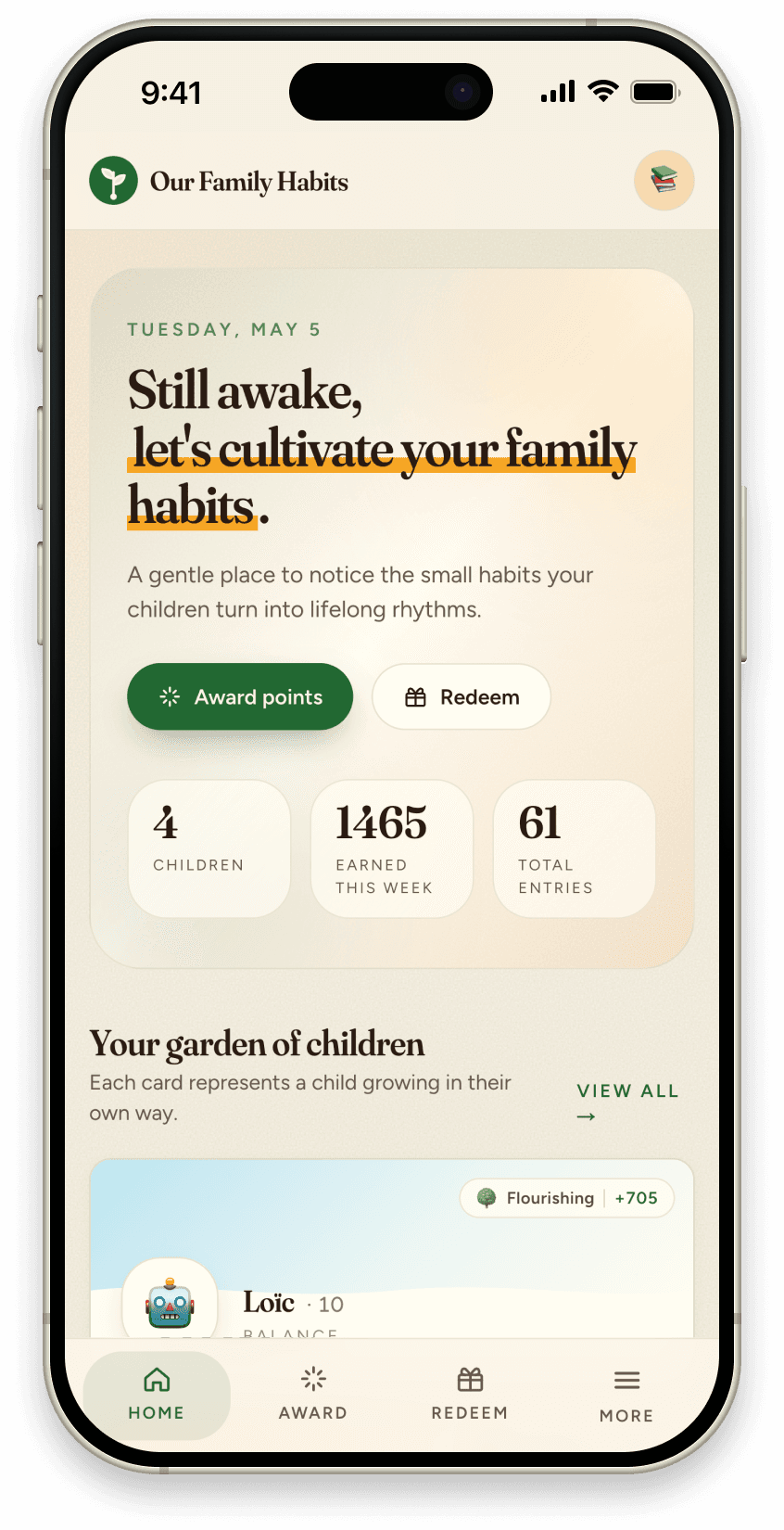
How a family habit tracker builds strong families and lasting rhythms
A family habit tracker turns good intentions into daily rhythms kids can see. Here's how shared visibility builds the habits — and the family — you want.
By Jon Horton ·

Most families don’t fall apart for lack of love. They fray at the edges — the same morning argument, the chore that never gets done, the screen-time negotiation that resets every single day. The work of a home is mostly small, repeated, and invisible. And what stays invisible is hard to build on.
A family habit tracker is a simple fix for an old problem: it makes the small daily work visible to everyone, so the rhythms you want actually take hold instead of resetting each morning. This post is about how that works — not the app features, but the underlying shift that turns scattered good intentions into the steady patterns that make a family strong.
Strong families run on rhythms, not willpower
The families that feel calm rarely have more discipline than yours. They have better rhythms. A rhythm is a habit the whole house shares — a known shape to the morning, a known way the day winds down, a known answer to “what happens next.” When the pattern carries the day, nobody has to spend willpower deciding it again.
This is the oldest idea in family formation. Charlotte Mason called habit-training the chief work of a parent: you lay one rail at a time, patiently, until the day runs on rails you no longer have to think about. The hard part was never the philosophy. It was the follow-through — keeping the new habit alive past the third day, across multiple kids, when life is loud.
That follow-through is exactly what a tracker protects.
What a family habit tracker actually does
Stripped down, a good family habit tracker does three things:
-
Names the habits out loud. You decide the handful of daily actions that matter — reading, music practice, helping a sibling, tidying after dinner — and they stop being nagging and start being a shared list everyone can see.
-
Makes progress visible to the whole family. This is the part that changes things. When everyone reads from the same page, the conversation shifts from who did more? to what did each of us actually do?
-
Closes the loop with encouragement. Effort gets noticed the moment it happens, so the habit gets a little reward of attention before it has a chance to fade.
None of that is about control. It’s about visibility — and visibility is the quiet engine under every strong family rhythm.
Why shared visibility beats nagging
When you are the only one who can see the whole picture, you become the family’s referee. Every request for credit and every complaint about a sibling flows through one bottleneck — you — and your judgment is the final word. It’s exhausting for you and disempowering for them.
Put the same information on a shared family kiosk where everyone walks past it, and the dynamic changes. We wrote more about this in from chore wars to teamwork, but the short version: kids stop arguing about fairness when fairness is something they can see instead of something they have to win from a parent. The system holds the standard, so you don’t have to repeat it.
That’s the difference between nagging and rhythm. Nagging is a parent re-deciding the same expectation every day. Rhythm is the expectation living somewhere outside your voice.
Build the habit, not just the chart
A wall of stickers can stop working fast — usually because the reward becomes the point and the habit underneath never roots. We dug into why sticker charts stop working separately, but it matters here too: a family habit tracker should reward the behavior you want repeated, then get out of the way.
That’s why the rewards in a good tracker are tied to real actions a child took, and why family insights show you the trend over weeks rather than the score on any single day. You’re not managing a points economy. You’re watching a habit take root, and adjusting the rails when one isn’t holding.
How to start — one rail at a time
You don’t build a strong family rhythm by tracking everything. You build it by tracking a few things consistently. A simple first week:
- Pick three or four habits the whole house genuinely cares about. Resist the urge to list ten.
- Give each an honest value that reflects real effort, so credit feels fair.
- Put the tracker where everyone passes it — the kiosk on a spare tablet is the highest-leverage move here.
- Watch for two weeks before changing anything. Habits need a runway before you judge them.
Then listen. The arguments move from who did what to what should we do next — and that better question is the real sign the rhythm is forming.
Different families, different rhythms
There’s no single right pattern. The right rhythm depends on the shape of your home:
- Homeschool families use a tracker to give an open, self-directed day a gentle spine without turning it into a schedule.
- Charlotte Mason families lean on it for the slow, one-habit-at-a-time formation they already believe in.
- Multi-kid families use shared visibility to honor each child’s pace while keeping the whole household reading from the same page.
What they share is the underlying mechanic: name the habits, make them visible, encourage the effort, and let the rhythm — not your willpower — carry the day.
The small daily work is the whole thing
Strong families aren’t built in big moments. They’re built in the small, repeated, easy-to-miss work of an ordinary Tuesday. A family habit tracker doesn’t add more to that work — it makes it visible, shared, and a little easier to keep, which is exactly what a habit needs to survive.
If you want to see how it works in your home, start with Our Family Habits — or look at the plans first. Either way, pick one rail this week and lay it down. The day will start to run on it.